

Random House Publishing Group
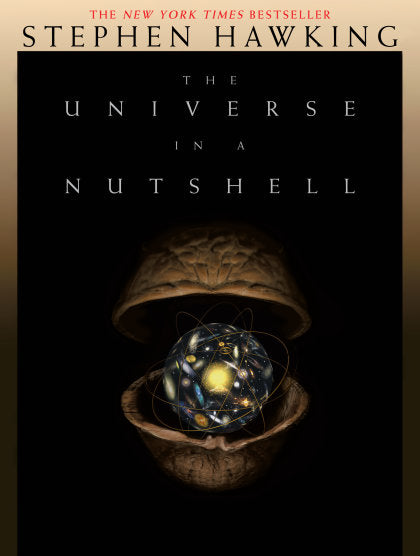
The Universe in a Nutshell
The Universe in a Nutshell
Couldn't load pickup availability
Collapsible content
ABOUT
Now, in a major publishing event, Hawking returns with a lavishly illustrated sequel that unravels the mysteries of the major breakthroughs that have occurred in the years since the release of his acclaimed first book.
The Universe in a Nutshell
• Quantum mechanics
• M-theory
• General relativity
• 11-dimensional supergravity
• 10-dimensional membranes
• Superstrings
• P-branes
• Black holes
One of the most influential thinkers of our time, Stephen Hawking is an intellectual icon, known not only for the adventurousness of his ideas but for the clarity and wit with which he expresses them. In this new book Hawking takes us to the cutting edge of theoretical physics, where truth is often stranger than fiction, to explain in laymen’s terms the principles that control our universe.
Like many in the community of theoretical physicists, Professor Hawking is seeking to uncover the grail of science — the elusive Theory of Everything that lies at the heart of the cosmos. In his accessible and often playful style, he guides us on his search to uncover the secrets of the universe — from supergravity to supersymmetry, from quantum theory to M-theory, from holography to duality.
He takes us to the wild frontiers of science, where superstring theory and p-branes may hold the final clue to the puzzle. And he lets us behind the scenes of one of his most exciting intellectual adventures as he seeks “to combine Einstein’s General Theory of Relativity and Richard Feynman’s idea of multiple histories into one complete unified theory that will describe everything that happens in the universe.”
With characteristic exuberance, Professor Hawking invites us to be fellow travelers on this extraordinary voyage through space-time. Copious four-color illustrations help clarify this journey into a surreal wonderland where particles, sheets, and strings move in eleven dimensions; where black holes evaporate and disappear, taking their secret with them; and where the original cosmic seed from which our own universe sprang was a tiny nut.
The Universe in a Nutshell is essential reading for all of us who want to understand the universe in which we live. Like its companion volume, A Brief History of Time, it conveys the excitement felt within the scientific community as the secrets of the cosmos reveal themselves.
STANDARD, PRIMARY, DM AND VARIANT COVERS
Standard and Primary covers are widely available through general retailers. They often have higher print runs and can be cheaper, especially during sales.
In contrast, Direct Market (DM) and variant covers are primarily sold in comic shops. DM editions tend to have more limited availability and may be more valuable to collectors.
The main differences lie in artwork style, availability, price, and collector appeal. Ultimately, the choice between standard and variant covers depends on personal preference, budget, and individual collecting goals.
PRODUCT TYPES
Comic book enthusiasts have various formats to choose from when collecting their favorite stories.
Here's a brief overview of the main types:
Omnibus
- Large, hardcover collections
- Usually contain complete runs or extensive story arcs
- Typically 800-1000+ pages
- Higher price point, often €100-€150
Oversized Hardcover (OHC)
- Similar dimensions to omnibus, but thinner
- Collect shorter runs or story arcs
- Usually 300-600 pages
- Priced between €30-€50
Hardcover (HC)
- Standard-sized hardcover books
- Collect 6-12 issues typically
- Similar dimensions to single issues, but with a hard cover
- Priced around €25-€35
Trade Paperback (TP)
- Softcover collections
- Standard comic book size
- Usually collect 4-6 issues
- Most affordable option, typically €15-€25
Other Formats
- Absolute Editions: Oversized, deluxe hardcovers (mainly DC Comics)
- Compendiums: Massive paperback collections
- Graphic Novels (OGN/GN): Original stories not previously released as single issues
The choice between these formats often depends on personal preference, budget, and collecting goals. Omnibus and OHC editions offer larger artwork and more content but at a higher price, while TPs provide a more affordable way to collect complete story arcs