

Crown
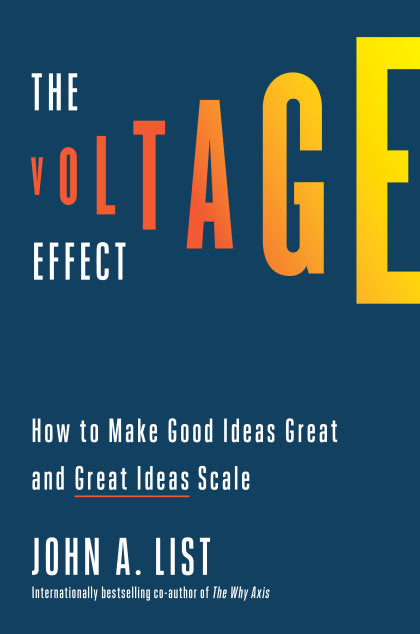
The Voltage Effect
The Voltage Effect
Couldn't load pickup availability
Collapsible content
ABOUT
“Brilliant, practical, and grounded in the very latest research, this is by far the best book I’ve ever read on the how and why of scaling.”—Angela Duckworth, CEO of Character Lab and New York Times bestselling author of Grit
LONGLISTED FOR THE PORCHLIGHT BUSINESS BOOK AWARD
“Scale” has become a favored buzzword in the startup world. But scale isn't just about accumulating more users or capturing more market share. It's about whether an idea that takes hold in a small group can do the same in a much larger one—whether you’re growing a small business, rolling out a diversity and inclusion program, or delivering billions of doses of a vaccine.
Translating an idea into widespread impact, says University of Chicago economist John A. List, depends on one thing only: whether it can achieve “high voltage”—the ability to be replicated at scale.
In The Voltage Effect, List explains that scalable ideas share a common set of attributes, while any number of attributes can doom an unscalable idea. Drawing on his original research, as well as fascinating examples from the realms of business, policymaking, education, and public health, he identifies five measurable vital signs that a scalable idea must possess, and offers proven strategies for avoiding voltage drops and engineering voltage gains. You’ll learn:
• How celebrity chef Jamie Oliver expanded his restaurant empire by focusing on scalable “ingredients” (until it collapsed because talent doesn’t scale)
• Why the failure to detect false positives early on caused the Reagan-era drug-prevention program to backfire at scale
• How governments could deliver more services to more citizens if they focused on the last dollar spent
• How one education center leveraged positive spillovers to narrow the achievement gap across the entire community
• Why the right set of incentives, applied at scale, can boost voter turnout, increase clean energy use, encourage patients to consistently take their prescribed medication, and more.
By understanding the science of scaling, we can drive change in our schools, workplaces, communities, and society at large. Because a better world can only be built at scale.
STANDARD, PRIMARY, DM AND VARIANT COVERS
Standard and Primary covers are widely available through general retailers. They often have higher print runs and can be cheaper, especially during sales.
In contrast, Direct Market (DM) and variant covers are primarily sold in comic shops. DM editions tend to have more limited availability and may be more valuable to collectors.
The main differences lie in artwork style, availability, price, and collector appeal. Ultimately, the choice between standard and variant covers depends on personal preference, budget, and individual collecting goals.
PRODUCT TYPES
Comic book enthusiasts have various formats to choose from when collecting their favorite stories.
Here's a brief overview of the main types:
Omnibus
- Large, hardcover collections
- Usually contain complete runs or extensive story arcs
- Typically 800-1000+ pages
- Higher price point, often €100-€150
Oversized Hardcover (OHC)
- Similar dimensions to omnibus, but thinner
- Collect shorter runs or story arcs
- Usually 300-600 pages
- Priced between €30-€50
Hardcover (HC)
- Standard-sized hardcover books
- Collect 6-12 issues typically
- Similar dimensions to single issues, but with a hard cover
- Priced around €25-€35
Trade Paperback (TP)
- Softcover collections
- Standard comic book size
- Usually collect 4-6 issues
- Most affordable option, typically €15-€25
Other Formats
- Absolute Editions: Oversized, deluxe hardcovers (mainly DC Comics)
- Compendiums: Massive paperback collections
- Graphic Novels (OGN/GN): Original stories not previously released as single issues
The choice between these formats often depends on personal preference, budget, and collecting goals. Omnibus and OHC editions offer larger artwork and more content but at a higher price, while TPs provide a more affordable way to collect complete story arcs