

Penguin Publishing Group
The Woman in the Purple Skirt
The Woman in the Purple Skirt
Couldn't load pickup availability
Collapsible content
ABOUT
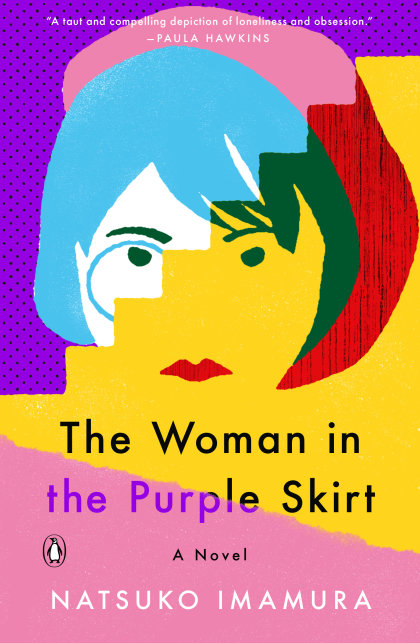
“A taut and compelling depiction of loneliness and obsession.” --Paula Hawkins, #1 New York Times bestselling author of The Girl on the Train
“[It] will keep you firmly in its grip.” --Oyinkan Braithwaite, bestselling author of My Sister, the Serial Killer
“The love child of Eugene Ionesco and Patricia Highsmith.” --Kelly Link, bestselling author of Get in Trouble
A bestselling, prizewinning novel by one of Japan's most acclaimed young writers, for fans of Convenience Store Woman, Eleanor Oliphant Is Completely Fine, and the movies Parasite and Rear Window
I think what I'm trying to say is that I've been wanting to become friends with the Woman in the Purple Skirt for a very long time...
Almost every afternoon, the Woman in the Purple Skirt sits on the same park bench, where she eats a cream bun while the local children make a game of trying to get her attention. Unbeknownst to her, she is being watched--by the Woman in the Yellow Cardigan, who is always perched just out of sight, monitoring which buses she takes, what she eats, whom she speaks to.
From a distance, the Woman in the Purple Skirt looks like a schoolgirl, but there are age spots on her face, and her hair is dry and stiff. She is single, she lives in a small apartment, and she is short on money--just like the Woman in the Yellow Cardigan, who lures her to a job as a housekeeper at a hotel, where she too is a housekeeper. Soon, the Woman in the Purple Skirt is having an affair with the boss and all eyes are on her. But no one knows or cares about the Woman in the Yellow Cardigan. That's the difference between her and the Woman in the Purple Skirt.
Studiously deadpan and chillingly voyeuristic, and with the off-kilter appeal of the novels of Ottessa Moshfegh, The Woman in the Purple Skirt explores envy, loneliness, power dynamics, and the vulnerability of unmarried women in a taut, suspenseful narrative about the sometimes desperate desire to be seen.
STANDARD, PRIMARY, DM AND VARIANT COVERS
Standard and Primary covers are widely available through general retailers. They often have higher print runs and can be cheaper, especially during sales.
In contrast, Direct Market (DM) and variant covers are primarily sold in comic shops. DM editions tend to have more limited availability and may be more valuable to collectors.
The main differences lie in artwork style, availability, price, and collector appeal. Ultimately, the choice between standard and variant covers depends on personal preference, budget, and individual collecting goals.
PRODUCT TYPES
Comic book enthusiasts have various formats to choose from when collecting their favorite stories.
Here's a brief overview of the main types:
Omnibus
- Large, hardcover collections
- Usually contain complete runs or extensive story arcs
- Typically 800-1000+ pages
- Higher price point, often €100-€150
Oversized Hardcover (OHC)
- Similar dimensions to omnibus, but thinner
- Collect shorter runs or story arcs
- Usually 300-600 pages
- Priced between €30-€50
Hardcover (HC)
- Standard-sized hardcover books
- Collect 6-12 issues typically
- Similar dimensions to single issues, but with a hard cover
- Priced around €25-€35
Trade Paperback (TP)
- Softcover collections
- Standard comic book size
- Usually collect 4-6 issues
- Most affordable option, typically €15-€25
Other Formats
- Absolute Editions: Oversized, deluxe hardcovers (mainly DC Comics)
- Compendiums: Massive paperback collections
- Graphic Novels (OGN/GN): Original stories not previously released as single issues
The choice between these formats often depends on personal preference, budget, and collecting goals. Omnibus and OHC editions offer larger artwork and more content but at a higher price, while TPs provide a more affordable way to collect complete story arcs