

Beacon Press
They Just Need to Get a Job
They Just Need to Get a Job
Couldn't load pickup availability
Collapsible content
ABOUT
—Booklist, Starred Review
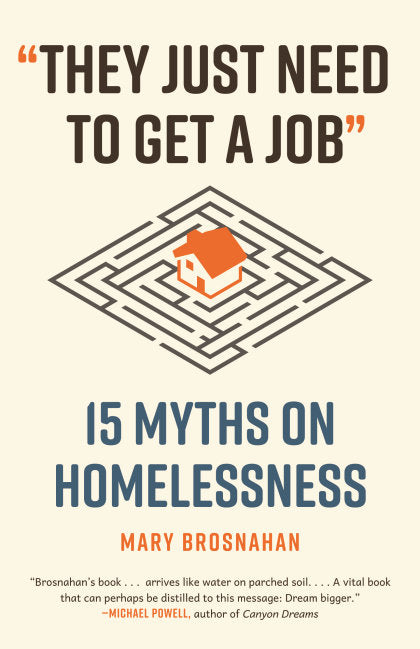
For readers of Andrea Elliott and Matthew Desmond, the former CEO of the Coalition for the Homeless breaks through the highly destructive misinformation surrounding our homeless neighbors
As the COVID-19 crisis put millions of Americans in danger of eviction, the nation’s affordable housing crisis has reached new heights. Yet Conservative think tanks like the Manhattan Institute continue to disseminate anti-homeless myths in the media, legislatures, and the larger culture:
- “These people just need to learn to save money.”
- “Most homeless people are mentally ill and dangerous.”
- “Runaways aren't really homeless.”
Drawing on her deep legal knowledge, policy expertise, and decades of frontline service, Mary Brosnahan cuts through the misinformation to deliver two important messages: that homelessness ultimately stems from a lack of investment in affordable housing; and that the greatest myth of all is that we should have no hope. In fact, the proven solutions are well documented, and the ability to enact them depends on us all.
Brosnahan takes a nationwide look from New York to Detroit to rural areas such as Cumberland County, Pennsylvania, to debunk 15 widespread misconceptions, including:
- that the problem is inevitable (in fact, Housing First approaches have shown great success)
- that “handouts” cause homelessness (in fact, the primary causes are flat wages and high rent)
- that homeless people need to prove that they’re “ready” to receive aid (in fact, enforcing hurdles is far more expensive and less effective than Housing First).
With brilliant insight, Brosnahan showcases how by dispelling these pervasive myths rooted in fear, we can embrace the affordable, housing-based solutions that will bring our impoverished neighbors home.
STANDARD, PRIMARY, DM AND VARIANT COVERS
Standard and Primary covers are widely available through general retailers. They often have higher print runs and can be cheaper, especially during sales.
In contrast, Direct Market (DM) and variant covers are primarily sold in comic shops. DM editions tend to have more limited availability and may be more valuable to collectors.
The main differences lie in artwork style, availability, price, and collector appeal. Ultimately, the choice between standard and variant covers depends on personal preference, budget, and individual collecting goals.
PRODUCT TYPES
Comic book enthusiasts have various formats to choose from when collecting their favorite stories.
Here's a brief overview of the main types:
Omnibus
- Large, hardcover collections
- Usually contain complete runs or extensive story arcs
- Typically 800-1000+ pages
- Higher price point, often €100-€150
Oversized Hardcover (OHC)
- Similar dimensions to omnibus, but thinner
- Collect shorter runs or story arcs
- Usually 300-600 pages
- Priced between €30-€50
Hardcover (HC)
- Standard-sized hardcover books
- Collect 6-12 issues typically
- Similar dimensions to single issues, but with a hard cover
- Priced around €25-€35
Trade Paperback (TP)
- Softcover collections
- Standard comic book size
- Usually collect 4-6 issues
- Most affordable option, typically €15-€25
Other Formats
- Absolute Editions: Oversized, deluxe hardcovers (mainly DC Comics)
- Compendiums: Massive paperback collections
- Graphic Novels (OGN/GN): Original stories not previously released as single issues
The choice between these formats often depends on personal preference, budget, and collecting goals. Omnibus and OHC editions offer larger artwork and more content but at a higher price, while TPs provide a more affordable way to collect complete story arcs