

Random House Publishing Group
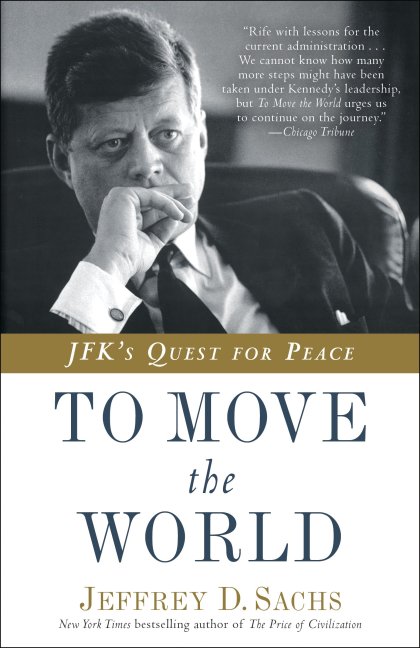
To Move the World
To Move the World
Couldn't load pickup availability
Collapsible content
ABOUT
The last great campaign of John F. Kennedy’s life was not the battle for reelection he did not live to wage, but the struggle for a sustainable peace with the Soviet Union. To Move the World recalls the extraordinary days from October 1962 to September 1963, when JFK marshaled the power of oratory and his remarkable political skills to establish more peaceful relations with the Soviet Union and a dramatic slowdown in the proliferation of nuclear arms.
Kennedy and his Soviet counterpart, Nikita Khrushchev, led their nations during the Cuban Missile Crisis, when the two superpowers came eyeball to eyeball at the nuclear abyss. This near-death experience shook both leaders deeply. Jeffrey D. Sachs shows how Kennedy emerged from the Missile crisis with the determination and prodigious skills to forge a new and less threatening direction for the world. Together, he and Khrushchev would pull the world away from the nuclear precipice, charting a path for future peacemakers to follow.
During his final year in office, Kennedy gave a series of speeches in which he pushed back against the momentum of the Cold War to persuade the world that peace with the Soviets was possible. The oratorical high point came on June 10, 1963, when Kennedy delivered the most important foreign policy speech of the modern presidency. He argued against the prevailing pessimism that viewed humanity as doomed by forces beyond its control. Mankind, argued Kennedy, could bring a new peace into reality through a bold vision combined with concrete and practical measures.
Achieving the first of those measures in the summer of 1963, the Partial Nuclear Test Ban Treaty, required more than just speechmaking, however. Kennedy had to use his great gifts of persuasion on multiple fronts—with fractious allies, hawkish Republican congressmen, dubious members of his own administration, and the American and world public—to persuade a skeptical world that cooperation between the superpowers was realistic and necessary. Sachs shows how Kennedy campaigned for his vision and opened the eyes of the American people and the world to the possibilities of peace.
Featuring the full text of JFK’s speeches from this period, as well as striking photographs, To Move the World gives us a startlingly fresh perspective on Kennedy’s presidency and a model for strong leadership and problem solving in our time.
Praise for To Move the World
“Rife with lessons for the current administration . . . We cannot know how many more steps might have been taken under Kennedy’s leadership, but To Move the World urges us to continue on the journey.”—Chicago Tribune
“The messages in these four speeches seem all too pertinent today.”—Publishers Weekly
STANDARD, PRIMARY, DM AND VARIANT COVERS
Standard and Primary covers are widely available through general retailers. They often have higher print runs and can be cheaper, especially during sales.
In contrast, Direct Market (DM) and variant covers are primarily sold in comic shops. DM editions tend to have more limited availability and may be more valuable to collectors.
The main differences lie in artwork style, availability, price, and collector appeal. Ultimately, the choice between standard and variant covers depends on personal preference, budget, and individual collecting goals.
PRODUCT TYPES
Comic book enthusiasts have various formats to choose from when collecting their favorite stories.
Here's a brief overview of the main types:
Omnibus
- Large, hardcover collections
- Usually contain complete runs or extensive story arcs
- Typically 800-1000+ pages
- Higher price point, often €100-€150
Oversized Hardcover (OHC)
- Similar dimensions to omnibus, but thinner
- Collect shorter runs or story arcs
- Usually 300-600 pages
- Priced between €30-€50
Hardcover (HC)
- Standard-sized hardcover books
- Collect 6-12 issues typically
- Similar dimensions to single issues, but with a hard cover
- Priced around €25-€35
Trade Paperback (TP)
- Softcover collections
- Standard comic book size
- Usually collect 4-6 issues
- Most affordable option, typically €15-€25
Other Formats
- Absolute Editions: Oversized, deluxe hardcovers (mainly DC Comics)
- Compendiums: Massive paperback collections
- Graphic Novels (OGN/GN): Original stories not previously released as single issues
The choice between these formats often depends on personal preference, budget, and collecting goals. Omnibus and OHC editions offer larger artwork and more content but at a higher price, while TPs provide a more affordable way to collect complete story arcs