

Beacon Press
Touched Out
Touched Out
Couldn't load pickup availability
Collapsible content
ABOUT
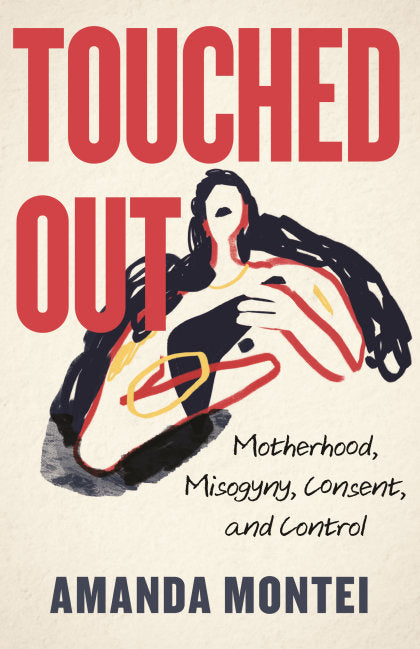
Motherhood and the culture of misogyny in America are not often explored in tandem. The connection is women’s bodies.
When Amanda Montei became a parent, she struggled with the physicality of caring for children, but even more with the growing lack of autonomy she felt in her personal and professional life. The conditions of modern American parenthood—the lack of paid leave and affordable childcare, the isolation and alienation, the distribution of labor in her home, and the implicit demands of marriage—were not what she had expected.
After #MeToo, however, she began to see a connection between how women were feeling in motherhood and the larger culture of assault in which she had grown up. In American society, women are expected to prioritize their children, often by pushing their bodies to the limit and ignoring their own desires and needs. As she struggled to adjust to the new demands on her body, this stirred memories of being used, violated, and seen by men. She had the desperate urge to finally say no, though she didn’t know how, or to whom she might say it.
Written with the intellectual and emotional precision of writers like Roxane Gay and Leslie Jamison, and drawing on classic feminist thinkers such as bell hooks, Silvia Federici, and Adrienne Rich, as well as on popular culture from The Bachelor to Look Who’s Talking, Montei draws connections between caregiving, consent, reproductive control, and the sacrifices women are expected to make throughout their lives. Exploring the stories we tell about psychology, childbirth, sexuality, the family, the overwhelm mothers feel trying to be “good,” and the tender bonds that form between parent and child, Touched Out delivers a powerful critique of American rape culture and its continuation in the institution of motherhood, and considers what it really means to care in America.
STANDARD, PRIMARY, DM AND VARIANT COVERS
Standard and Primary covers are widely available through general retailers. They often have higher print runs and can be cheaper, especially during sales.
In contrast, Direct Market (DM) and variant covers are primarily sold in comic shops. DM editions tend to have more limited availability and may be more valuable to collectors.
The main differences lie in artwork style, availability, price, and collector appeal. Ultimately, the choice between standard and variant covers depends on personal preference, budget, and individual collecting goals.
PRODUCT TYPES
Comic book enthusiasts have various formats to choose from when collecting their favorite stories.
Here's a brief overview of the main types:
Omnibus
- Large, hardcover collections
- Usually contain complete runs or extensive story arcs
- Typically 800-1000+ pages
- Higher price point, often €100-€150
Oversized Hardcover (OHC)
- Similar dimensions to omnibus, but thinner
- Collect shorter runs or story arcs
- Usually 300-600 pages
- Priced between €30-€50
Hardcover (HC)
- Standard-sized hardcover books
- Collect 6-12 issues typically
- Similar dimensions to single issues, but with a hard cover
- Priced around €25-€35
Trade Paperback (TP)
- Softcover collections
- Standard comic book size
- Usually collect 4-6 issues
- Most affordable option, typically €15-€25
Other Formats
- Absolute Editions: Oversized, deluxe hardcovers (mainly DC Comics)
- Compendiums: Massive paperback collections
- Graphic Novels (OGN/GN): Original stories not previously released as single issues
The choice between these formats often depends on personal preference, budget, and collecting goals. Omnibus and OHC editions offer larger artwork and more content but at a higher price, while TPs provide a more affordable way to collect complete story arcs