

Beacon Press
Toxic
Toxic
Couldn't load pickup availability
Collapsible content
ABOUT
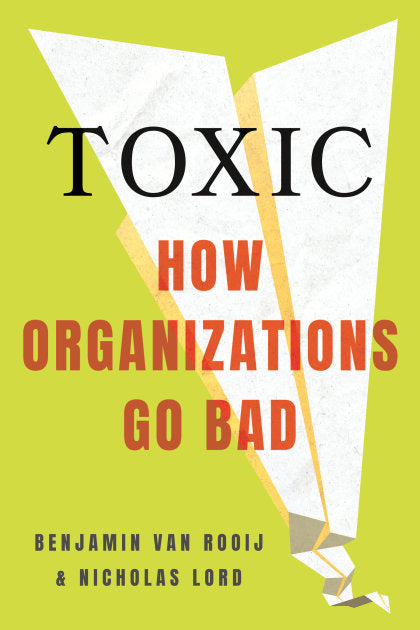
While we often read about corporate scandals, we are left wondering: why do organizations keep causing harm?
Benjamin van Rooij and Nicholas Lord argue that to truly understand and address the impacts of dysfunctional organizations we must look beyond the senior executives and/or leaders and understand the deeper problems in the organization itself. To do so, Toxic uses dozens of in-depth case studies to connect the dots between various scandals and illustrate the deeper toxic patterns within organizations that lead to them.
Each chapter recounts compelling stories of individuals caught within these toxic systems and addresses urgent societal challenges such as environmental degradation, the opioid epidemic, the harms of social media, and police abuse. Stories include:
- Boeing focusing so much on its day-to-day share price that it lost sight of ensuring the long-term safety of its 737 MAX airplanes.
- Volkswagen experimenting with monkeys locked in cages breathing exhaust fumes in a desperate attempt to deny the harm of its “clean diesel” engines.
- How the Oakland Police Department taught its rookies to engage in racist and abusive policing practices, resisting decades-long attempts to reform the department.
Revealing, accessible, and engaging, Toxic, breaks down the core characteristics of toxic organizations and shows readers how to recognize and address toxicity in their everyday lives.
STANDARD, PRIMARY, DM AND VARIANT COVERS
Standard and Primary covers are widely available through general retailers. They often have higher print runs and can be cheaper, especially during sales.
In contrast, Direct Market (DM) and variant covers are primarily sold in comic shops. DM editions tend to have more limited availability and may be more valuable to collectors.
The main differences lie in artwork style, availability, price, and collector appeal. Ultimately, the choice between standard and variant covers depends on personal preference, budget, and individual collecting goals.
PRODUCT TYPES
Comic book enthusiasts have various formats to choose from when collecting their favorite stories.
Here's a brief overview of the main types:
Omnibus
- Large, hardcover collections
- Usually contain complete runs or extensive story arcs
- Typically 800-1000+ pages
- Higher price point, often €100-€150
Oversized Hardcover (OHC)
- Similar dimensions to omnibus, but thinner
- Collect shorter runs or story arcs
- Usually 300-600 pages
- Priced between €30-€50
Hardcover (HC)
- Standard-sized hardcover books
- Collect 6-12 issues typically
- Similar dimensions to single issues, but with a hard cover
- Priced around €25-€35
Trade Paperback (TP)
- Softcover collections
- Standard comic book size
- Usually collect 4-6 issues
- Most affordable option, typically €15-€25
Other Formats
- Absolute Editions: Oversized, deluxe hardcovers (mainly DC Comics)
- Compendiums: Massive paperback collections
- Graphic Novels (OGN/GN): Original stories not previously released as single issues
The choice between these formats often depends on personal preference, budget, and collecting goals. Omnibus and OHC editions offer larger artwork and more content but at a higher price, while TPs provide a more affordable way to collect complete story arcs