

Crown
Trespassers at the Golden Gate
Trespassers at the Golden Gate
Couldn't load pickup availability
Collapsible content
ABOUT
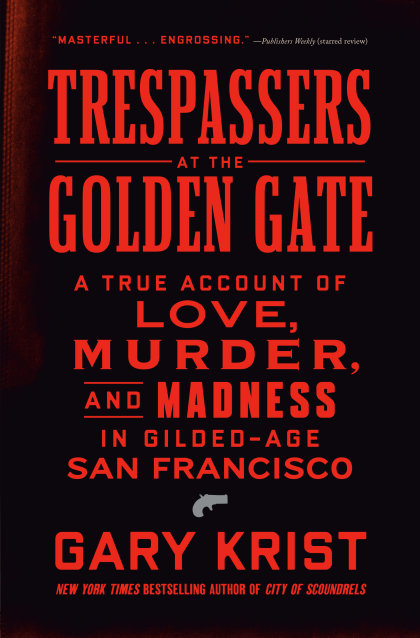
Shortly before dusk on November 3, 1870, just as the ferryboat El Capitan was pulling away from its slip into San Francisco Bay, a woman clad in black emerged from the shadows and strode across the crowded deck. Reaching under her veil, she drew a small pistol and aimed it directly at a well-dressed man sitting quietly with his wife and children. The woman fired a single bullet into his chest. “I did it and I don’t deny it,” she said when arrested shortly thereafter. “He ruined both myself and my daughter.”
Though little remembered today, the trial of Laura D. Fair for the murder of her lover, A. P. Crittenden, made headlines nationwide. As bestselling author Gary Krist reveals, the operatic facts of the case—a woman strung along for years by a two-timing man, killing him in an alleged fit of madness—challenged an American populace still searching for moral consensus after the Civil War. The trial shone an early and uncomfortable spotlight on social issues like the role of women, the sanctity of the family, and the range of acceptable expressions of gender, while jolting the still-adolescent metropolis of 1870s San Francisco, a city eager to shed its rough-and-tumble Gold Rush-era reputation.
Trespassers at the Golden Gate brings readers inside the untamed frontier town, a place where—for a brief period—otherwise marginalized communities found unique opportunities. Readers meet a secretly wealthy Black housekeeper, an enterprising Chinese brothel madam, and a French rabble-rouser who refused to dress in sufficiently “feminine” clothing—as well as familiar figures like Mark Twain and Susan B. Anthony, who become swept up in the drama of the Laura Fair affair.
Krist, who previously brought New Orleans to vivid life in Empire of Sin and Chicago in City of Scoundrels, recounts this astonishing story and its surprisingly modern echoes in a rollicking narrative that probes what it all meant—both for a nation still scarred by war and for a city eager for the world stage.
STANDARD, PRIMARY, DM AND VARIANT COVERS
Standard and Primary covers are widely available through general retailers. They often have higher print runs and can be cheaper, especially during sales.
In contrast, Direct Market (DM) and variant covers are primarily sold in comic shops. DM editions tend to have more limited availability and may be more valuable to collectors.
The main differences lie in artwork style, availability, price, and collector appeal. Ultimately, the choice between standard and variant covers depends on personal preference, budget, and individual collecting goals.
PRODUCT TYPES
Comic book enthusiasts have various formats to choose from when collecting their favorite stories.
Here's a brief overview of the main types:
Omnibus
- Large, hardcover collections
- Usually contain complete runs or extensive story arcs
- Typically 800-1000+ pages
- Higher price point, often €100-€150
Oversized Hardcover (OHC)
- Similar dimensions to omnibus, but thinner
- Collect shorter runs or story arcs
- Usually 300-600 pages
- Priced between €30-€50
Hardcover (HC)
- Standard-sized hardcover books
- Collect 6-12 issues typically
- Similar dimensions to single issues, but with a hard cover
- Priced around €25-€35
Trade Paperback (TP)
- Softcover collections
- Standard comic book size
- Usually collect 4-6 issues
- Most affordable option, typically €15-€25
Other Formats
- Absolute Editions: Oversized, deluxe hardcovers (mainly DC Comics)
- Compendiums: Massive paperback collections
- Graphic Novels (OGN/GN): Original stories not previously released as single issues
The choice between these formats often depends on personal preference, budget, and collecting goals. Omnibus and OHC editions offer larger artwork and more content but at a higher price, while TPs provide a more affordable way to collect complete story arcs