

Beacon Press
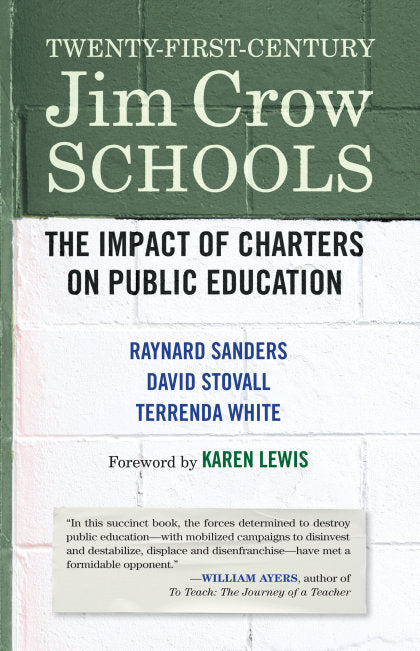
Twenty-First-Century Jim Crow Schools
Twenty-First-Century Jim Crow Schools
Couldn't load pickup availability
Collapsible content
ABOUT
Charter schools once promised a path towards educational equity, but as the authors of this powerful volume show, market-driven education reforms have instead boldly reestablished a tiered public school system that segregates students by race and class. Examining the rise of charters in New Orleans, Chicago, and New York, authors Raynard Sanders, David Stovall, and Terrenda White show how charters—private institutions, usually set in poor or working-class African American and Latinx communities—promote competition instead of collaboration and are driven chiefly by financial interests. Sanders, Stovall, and White also reveal how corporate charters position themselves as “public” to secure tax money but exploit their private status to hide data about enrollment and salaries, using misleading information to promote false narratives of student success.
In addition to showing how charter school expansion can deprive students of a quality education, the authors document several other lasting consequences of charter school expansion:
• the displacement of experienced African American teachers
• the rise of a rigid, militarized pedagogy such as SLANT
• the purposeful starvation of district schools
• and the loss of community control and oversight
A revealing and illuminating look at one of the greatest threats to public education, Twenty-First-Century Jim Crow Schools explores how charter schools have shaped the educational landscape and why parents, teachers, and community members are fighting back.
STANDARD, PRIMARY, DM AND VARIANT COVERS
Standard and Primary covers are widely available through general retailers. They often have higher print runs and can be cheaper, especially during sales.
In contrast, Direct Market (DM) and variant covers are primarily sold in comic shops. DM editions tend to have more limited availability and may be more valuable to collectors.
The main differences lie in artwork style, availability, price, and collector appeal. Ultimately, the choice between standard and variant covers depends on personal preference, budget, and individual collecting goals.
PRODUCT TYPES
Comic book enthusiasts have various formats to choose from when collecting their favorite stories.
Here's a brief overview of the main types:
Omnibus
- Large, hardcover collections
- Usually contain complete runs or extensive story arcs
- Typically 800-1000+ pages
- Higher price point, often €100-€150
Oversized Hardcover (OHC)
- Similar dimensions to omnibus, but thinner
- Collect shorter runs or story arcs
- Usually 300-600 pages
- Priced between €30-€50
Hardcover (HC)
- Standard-sized hardcover books
- Collect 6-12 issues typically
- Similar dimensions to single issues, but with a hard cover
- Priced around €25-€35
Trade Paperback (TP)
- Softcover collections
- Standard comic book size
- Usually collect 4-6 issues
- Most affordable option, typically €15-€25
Other Formats
- Absolute Editions: Oversized, deluxe hardcovers (mainly DC Comics)
- Compendiums: Massive paperback collections
- Graphic Novels (OGN/GN): Original stories not previously released as single issues
The choice between these formats often depends on personal preference, budget, and collecting goals. Omnibus and OHC editions offer larger artwork and more content but at a higher price, while TPs provide a more affordable way to collect complete story arcs