

Crown
Unfair
Unfair
Couldn't load pickup availability
Collapsible content
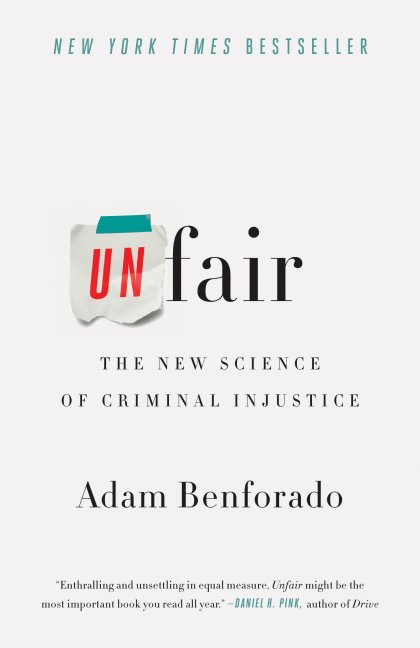
ABOUT
A child is gunned down by a police officer; an investigator ignores critical clues in a case; an innocent man confesses to a crime he did not commit; a jury acquits a killer. The evidence is all around us: Our system of justice is fundamentally broken.
But it’s not for the reasons we tend to think, as law professor Adam Benforado argues in this eye-opening, galvanizing book. Even if the system operated exactly as it was designed to, we would still end up with wrongful convictions, trampled rights, and unequal treatment. This is because the roots of injustice lie not inside the dark hearts of racist police officers or dishonest prosecutors, but within the minds of each and every one of us.
This is difficult to accept. Our nation is founded on the idea that the law is impartial, that legal cases are won or lost on the basis of evidence, careful reasoning and nuanced argument. But they may, in fact, turn on the camera angle of a defendant’s taped confession, the number of photos in a mug shot book, or a simple word choice during a cross-examination. In Unfair, Benforado shines a light on this troubling new field of research, showing, for example, that people with certain facial features receive longer sentences and that judges are far more likely to grant parole first thing in the morning.
Over the last two decades, psychologists and neuroscientists have uncovered many cognitive forces that operate beyond our conscious awareness. Until we address these hidden biases head-on, Benforado argues, the social inequality we see now will only widen, as powerful players and institutions find ways to exploit the weaknesses of our legal system.
Weaving together historical examples, scientific studies, and compelling court cases—from the border collie put on trial in Kentucky to the five teenagers who falsely confessed in the Central Park Jogger case—Benforado shows how our judicial processes fail to uphold our values and protect society’s weakest members. With clarity and passion, he lays out the scope of the legal system’s dysfunction and proposes a wealth of practical reforms that could prevent injustice and help us achieve true fairness and equality before the law.
STANDARD, PRIMARY, DM AND VARIANT COVERS
Standard and Primary covers are widely available through general retailers. They often have higher print runs and can be cheaper, especially during sales.
In contrast, Direct Market (DM) and variant covers are primarily sold in comic shops. DM editions tend to have more limited availability and may be more valuable to collectors.
The main differences lie in artwork style, availability, price, and collector appeal. Ultimately, the choice between standard and variant covers depends on personal preference, budget, and individual collecting goals.
PRODUCT TYPES
Comic book enthusiasts have various formats to choose from when collecting their favorite stories.
Here's a brief overview of the main types:
Omnibus
- Large, hardcover collections
- Usually contain complete runs or extensive story arcs
- Typically 800-1000+ pages
- Higher price point, often €100-€150
Oversized Hardcover (OHC)
- Similar dimensions to omnibus, but thinner
- Collect shorter runs or story arcs
- Usually 300-600 pages
- Priced between €30-€50
Hardcover (HC)
- Standard-sized hardcover books
- Collect 6-12 issues typically
- Similar dimensions to single issues, but with a hard cover
- Priced around €25-€35
Trade Paperback (TP)
- Softcover collections
- Standard comic book size
- Usually collect 4-6 issues
- Most affordable option, typically €15-€25
Other Formats
- Absolute Editions: Oversized, deluxe hardcovers (mainly DC Comics)
- Compendiums: Massive paperback collections
- Graphic Novels (OGN/GN): Original stories not previously released as single issues
The choice between these formats often depends on personal preference, budget, and collecting goals. Omnibus and OHC editions offer larger artwork and more content but at a higher price, while TPs provide a more affordable way to collect complete story arcs