

Penguin Publishing Group
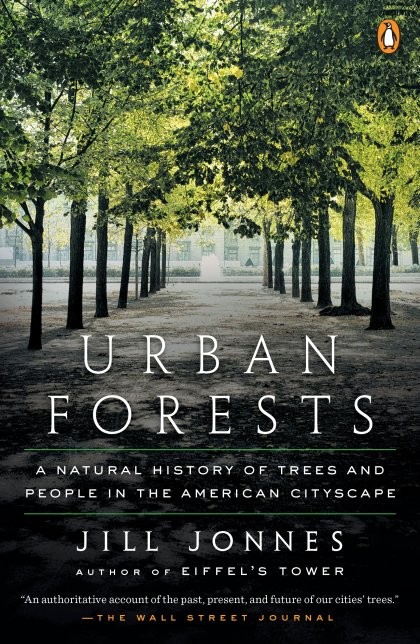
Urban Forests
Urban Forests
Couldn't load pickup availability
Collapsible content
ABOUT
“Jonnes extols the many contributions that trees make to city life and celebrates the men and women who stood up for America’s city trees over the past two centuries. . . . An authoritative account.” —Gerard Helferich, The Wall Street Journal
“We all know that trees can make streets look prettier. But in her new book Urban Forests, Jill Jonnes explains how they make them safer as well.” —Sara Begley, Time Magazine
A celebration of urban trees and the Americans—presidents, plant explorers, visionaries, citizen activists, scientists, nurserymen, and tree nerds—whose arboreal passions have shaped and ornamented the nation’s cities, from Jefferson’s day to the present
As nature’s largest and longest-lived creations, trees play an extraordinarily important role in our cities; they are living landmarks that define space, cool the air, soothe our psyches, and connect us to nature and our past. Today, four-fifths of Americans live in or near urban areas, surrounded by millions of trees of hundreds of different species. Despite their ubiquity and familiarity, most of us take trees for granted and know little of their fascinating natural history or remarkable civic virtues.
Jill Jonnes’s Urban Forests tells the captivating stories of the founding mothers and fathers of urban forestry, in addition to those arboreal advocates presently using the latest technologies to illuminate the value of trees to public health and to our urban infrastructure. The book examines such questions as the character of American urban forests and the effect that tree-rich landscaping might have on commerce, crime, and human well-being. For amateur botanists, urbanists, environmentalists, and policymakers, Urban Forests will be a revelation of one of the greatest, most productive, and most beautiful of our natural resources.
STANDARD, PRIMARY, DM AND VARIANT COVERS
Standard and Primary covers are widely available through general retailers. They often have higher print runs and can be cheaper, especially during sales.
In contrast, Direct Market (DM) and variant covers are primarily sold in comic shops. DM editions tend to have more limited availability and may be more valuable to collectors.
The main differences lie in artwork style, availability, price, and collector appeal. Ultimately, the choice between standard and variant covers depends on personal preference, budget, and individual collecting goals.
PRODUCT TYPES
Comic book enthusiasts have various formats to choose from when collecting their favorite stories.
Here's a brief overview of the main types:
Omnibus
- Large, hardcover collections
- Usually contain complete runs or extensive story arcs
- Typically 800-1000+ pages
- Higher price point, often €100-€150
Oversized Hardcover (OHC)
- Similar dimensions to omnibus, but thinner
- Collect shorter runs or story arcs
- Usually 300-600 pages
- Priced between €30-€50
Hardcover (HC)
- Standard-sized hardcover books
- Collect 6-12 issues typically
- Similar dimensions to single issues, but with a hard cover
- Priced around €25-€35
Trade Paperback (TP)
- Softcover collections
- Standard comic book size
- Usually collect 4-6 issues
- Most affordable option, typically €15-€25
Other Formats
- Absolute Editions: Oversized, deluxe hardcovers (mainly DC Comics)
- Compendiums: Massive paperback collections
- Graphic Novels (OGN/GN): Original stories not previously released as single issues
The choice between these formats often depends on personal preference, budget, and collecting goals. Omnibus and OHC editions offer larger artwork and more content but at a higher price, while TPs provide a more affordable way to collect complete story arcs