

Library of America
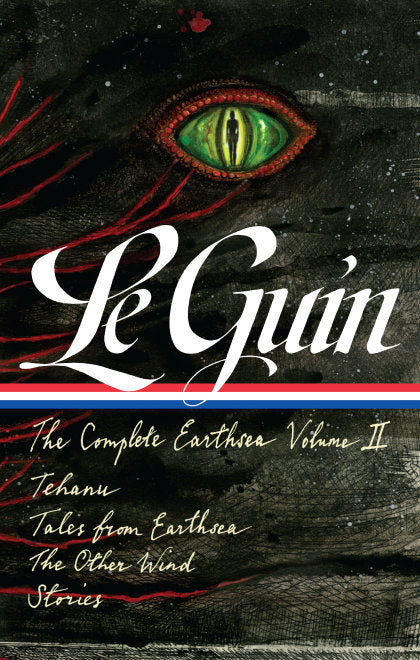
Ursula K. Le Guin: The Complete Earthsea, Volume Two (LOA #401)
Ursula K. Le Guin: The Complete Earthsea, Volume Two (LOA #401)
Couldn't load pickup availability
Collapsible content
ABOUT
“Ursula K. Le Guin has returned to Earthsea. This is very good news indeed. Le Guin, one of modern science fiction's most acclaimed writers, is also a fantasist of genius.”
—Gerald Jonas, The New York Times
Ursula K. Le Guin’s Earthsea novels and stories are set in the far-flung archipelago of Earthsea. The original three novels in the 1960s and 70s were the first and most successful of the descendants of J.R.R. Tolkien’s The Lord of the Rings and were the progenitors, in their turn, of all the wizard school and dragonlord fantasy series that have come since. But then Le Guin turned to Earthsea again, 18 years later, writing three more books that made Earthsea a far stranger and more compelling work still.
These later works are gathered here in the second volume in the Library of America's edition of the Complete Earthsea:
- Tehanu (1990), in which the widowed Tenar adopts a badly burned and abandoned child, a girl she names Tehanu. When Ged returns to Gont after losing his magic, Tenar helps him learn to live on the edge of things, even while an evil mage threatens their new life.
- Tales from Earthsea (2001) both reaches back in time to explore the beginnings of the school for mages on Roke and of Ged’s teacher Ogion, and, in “Dragonfly,” introduces Irian, a woman who realizes that she is other than what she seems.
- The Other Wind (2001), in which Irian meets Tehanu after Alder, a village sorcerer, travels in search of Ged to find out why he dreams every night that the stone wall that divides Earthsea from the Dry Land of death is crumbling. The answer turns out to have to do with Tehanu, Irian, and the people like them—and with the origin of magic in Earthsea.
Le Guin’s Earthsea is one of the most beloved and influential fantasy series of the 20th century.
STANDARD, PRIMARY, DM AND VARIANT COVERS
Standard and Primary covers are widely available through general retailers. They often have higher print runs and can be cheaper, especially during sales.
In contrast, Direct Market (DM) and variant covers are primarily sold in comic shops. DM editions tend to have more limited availability and may be more valuable to collectors.
The main differences lie in artwork style, availability, price, and collector appeal. Ultimately, the choice between standard and variant covers depends on personal preference, budget, and individual collecting goals.
PRODUCT TYPES
Comic book enthusiasts have various formats to choose from when collecting their favorite stories.
Here's a brief overview of the main types:
Omnibus
- Large, hardcover collections
- Usually contain complete runs or extensive story arcs
- Typically 800-1000+ pages
- Higher price point, often €100-€150
Oversized Hardcover (OHC)
- Similar dimensions to omnibus, but thinner
- Collect shorter runs or story arcs
- Usually 300-600 pages
- Priced between €30-€50
Hardcover (HC)
- Standard-sized hardcover books
- Collect 6-12 issues typically
- Similar dimensions to single issues, but with a hard cover
- Priced around €25-€35
Trade Paperback (TP)
- Softcover collections
- Standard comic book size
- Usually collect 4-6 issues
- Most affordable option, typically €15-€25
Other Formats
- Absolute Editions: Oversized, deluxe hardcovers (mainly DC Comics)
- Compendiums: Massive paperback collections
- Graphic Novels (OGN/GN): Original stories not previously released as single issues
The choice between these formats often depends on personal preference, budget, and collecting goals. Omnibus and OHC editions offer larger artwork and more content but at a higher price, while TPs provide a more affordable way to collect complete story arcs