

Catapult
Vista Del Mar
Vista Del Mar
Couldn't load pickup availability
Collapsible content
ABOUT
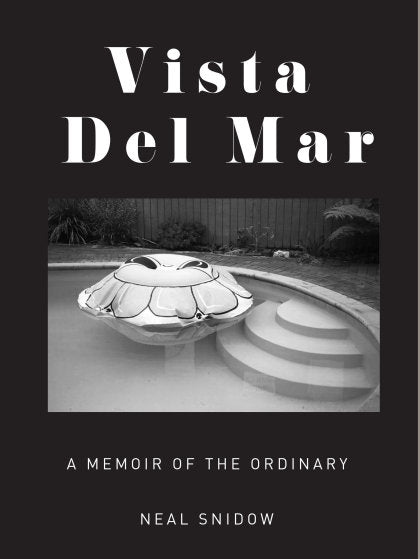
In 1996 Neal Snidow found himself at a personal impasse as he and his wife struggled in vain to have a child. Locked in sadness at their predicament, in mid–career as a college teacher and unpublished writer, and at the first daunting steps of open adoption, as a kind of solace Neal began taking black and white photos of his old neighborhood in southern California. The film was slow, the camera on a tripod, the process awkward, and the goal no more than Garry Winogrand's famous dictum that he made pictures "to find out what something will look like photographed."
But as this process unfolded and the images began to accumulate, slowly but surely the pictures unlocked the past, and he began to delve into family history, opening out the secret and the unspoken and evoking the lost pleasures and losses of the beach town where he had grown up. The chapters that followed, like the photos that now accompanied them, were quietly observant of an ordinary surface around which gathered an aura of struggle, gaiety and loss. He titled the book Vista Del Mar, for the street that ran past his old apartment to the edge of the Pacific, and gave it the subtitle a memoir of the ordinary in testimony to the everydayness of the experiences he explored. The chapters move back and forth in time and place, to Virginia, to a homestead in Wyoming, to depression–era Nebraska, to the Second World War. Aunts, uncles, ancestors, beach denizens, characters of film noir, and finally a miraculous new baby, all populate the pages which despite the struggles they relate conclude on a major chord of reconciliation and hope.
STANDARD, PRIMARY, DM AND VARIANT COVERS
Standard and Primary covers are widely available through general retailers. They often have higher print runs and can be cheaper, especially during sales.
In contrast, Direct Market (DM) and variant covers are primarily sold in comic shops. DM editions tend to have more limited availability and may be more valuable to collectors.
The main differences lie in artwork style, availability, price, and collector appeal. Ultimately, the choice between standard and variant covers depends on personal preference, budget, and individual collecting goals.
PRODUCT TYPES
Comic book enthusiasts have various formats to choose from when collecting their favorite stories.
Here's a brief overview of the main types:
Omnibus
- Large, hardcover collections
- Usually contain complete runs or extensive story arcs
- Typically 800-1000+ pages
- Higher price point, often €100-€150
Oversized Hardcover (OHC)
- Similar dimensions to omnibus, but thinner
- Collect shorter runs or story arcs
- Usually 300-600 pages
- Priced between €30-€50
Hardcover (HC)
- Standard-sized hardcover books
- Collect 6-12 issues typically
- Similar dimensions to single issues, but with a hard cover
- Priced around €25-€35
Trade Paperback (TP)
- Softcover collections
- Standard comic book size
- Usually collect 4-6 issues
- Most affordable option, typically €15-€25
Other Formats
- Absolute Editions: Oversized, deluxe hardcovers (mainly DC Comics)
- Compendiums: Massive paperback collections
- Graphic Novels (OGN/GN): Original stories not previously released as single issues
The choice between these formats often depends on personal preference, budget, and collecting goals. Omnibus and OHC editions offer larger artwork and more content but at a higher price, while TPs provide a more affordable way to collect complete story arcs