

Penguin Publishing Group
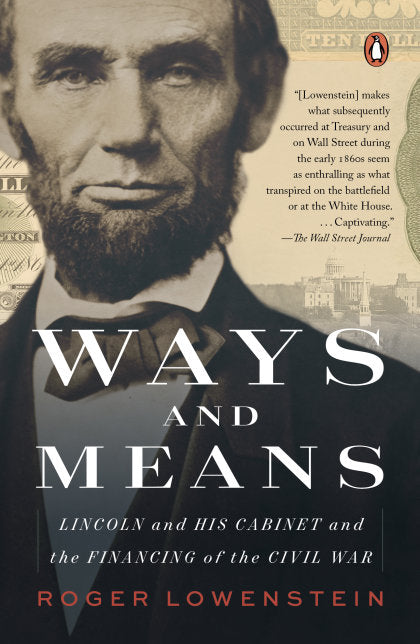
Ways and Means
Ways and Means
Couldn't load pickup availability
Collapsible content
ABOUT
“Ways and Means, an account of the Union’s financial policies, examines a subject long overshadowed by military narratives . . . Lowenstein is a lucid stylist, able to explain financial matters to readers who lack specialized knowledge.” —Eric Foner, New York Times Book Review
From renowned journalist and master storyteller Roger Lowenstein, a revelatory financial investigation into how Lincoln and his administration used the funding of the Civil War as the catalyst to centralize the government and accomplish the most far-reaching reform in the country’s history
Upon his election to the presidency, Abraham Lincoln inherited a country in crisis. Even before the Confederacy’s secession, the United States Treasury had run out of money. The government had no authority to raise taxes, no federal bank, no currency. But amid unprecedented troubles Lincoln saw opportunity—the chance to legislate in the centralizing spirit of the “more perfect union” that had first drawn him to politics. With Lincoln at the helm, the United States would now govern “for” its people: it would enact laws, establish a currency, raise armies, underwrite transportation and higher education, assist farmers, and impose taxes for them. Lincoln believed this agenda would foster the economic opportunity he had always sought for upwardly striving Americans, and which he would seek in particular for enslaved Black Americans.
Salmon Chase, Lincoln’s vanquished rival and his new secretary of the Treasury, waged war on the financial front, levying taxes and marketing bonds while desperately battling to contain wartime inflation. And while the Union and Rebel armies fought increasingly savage battles, the Republican-led Congress enacted a blizzard of legislation that made the government, for the first time, a powerful presence in the lives of ordinary Americans. The impact was revolutionary. The activist 37th Congress legislated for homesteads and a transcontinental railroad and involved the federal government in education, agriculture, and eventually immigration policy. It established a progressive income tax and created the greenback—paper money. While the Union became self-sustaining, the South plunged into financial free fall, having failed to leverage its cotton wealth to finance the war. Founded in a crucible of anticentralism, the Confederacy was trapped in a static (and slave-based) agrarian economy without federal taxing power or other means of government financing, save for its overworked printing presses. This led to an epic collapse. Though Confederate troops continued to hold their own, the North’s financial advantage over the South, where citizens increasingly went hungry, proved decisive; the war was won as much (or more) in the respective treasuries as on the battlefields.
Roger Lowenstein reveals the largely untold story of how Lincoln used the urgency of the Civil War to transform a union of states into a nation. Through a financial lens, he explores how this second American revolution, led by Lincoln, his cabinet, and a Congress studded with towering statesmen, changed the direction of the country and established a government of the people, by the people, and for the people.
STANDARD, PRIMARY, DM AND VARIANT COVERS
Standard and Primary covers are widely available through general retailers. They often have higher print runs and can be cheaper, especially during sales.
In contrast, Direct Market (DM) and variant covers are primarily sold in comic shops. DM editions tend to have more limited availability and may be more valuable to collectors.
The main differences lie in artwork style, availability, price, and collector appeal. Ultimately, the choice between standard and variant covers depends on personal preference, budget, and individual collecting goals.
PRODUCT TYPES
Comic book enthusiasts have various formats to choose from when collecting their favorite stories.
Here's a brief overview of the main types:
Omnibus
- Large, hardcover collections
- Usually contain complete runs or extensive story arcs
- Typically 800-1000+ pages
- Higher price point, often €100-€150
Oversized Hardcover (OHC)
- Similar dimensions to omnibus, but thinner
- Collect shorter runs or story arcs
- Usually 300-600 pages
- Priced between €30-€50
Hardcover (HC)
- Standard-sized hardcover books
- Collect 6-12 issues typically
- Similar dimensions to single issues, but with a hard cover
- Priced around €25-€35
Trade Paperback (TP)
- Softcover collections
- Standard comic book size
- Usually collect 4-6 issues
- Most affordable option, typically €15-€25
Other Formats
- Absolute Editions: Oversized, deluxe hardcovers (mainly DC Comics)
- Compendiums: Massive paperback collections
- Graphic Novels (OGN/GN): Original stories not previously released as single issues
The choice between these formats often depends on personal preference, budget, and collecting goals. Omnibus and OHC editions offer larger artwork and more content but at a higher price, while TPs provide a more affordable way to collect complete story arcs