

Penguin Publishing Group
We Are What We Eat
We Are What We Eat
Couldn't load pickup availability
Collapsible content
ABOUT
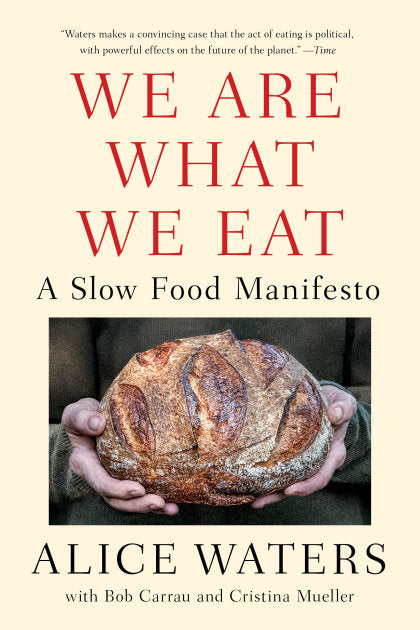
In We Are What We Eat, Alice Waters urges us to take up the mantle of slow food culture, the philosophy at the core of her life’s work. When Waters first opened Chez Panisse in 1971, she did so with the intention of feeding people good food during a time of political turmoil. Customers responded to the locally sourced organic ingredients, to the dishes made by hand, and to the welcoming hospitality that infused the small space—human qualities that were disappearing from a country increasingly seduced by takeout, frozen dinners, and prepackaged ingredients. Waters came to see that the phenomenon of fast food culture, which prioritized cheapness, availability, and speed, was not only ruining our health, but also dehumanizing the ways we live and relate to one another.
Over years of working with regional farmers, Waters and her partners learned how geography and seasonal fluctuations affect the ingredients on the menu, as well as about the dangers of pesticides, the plight of fieldworkers, and the social, economic, and environmental threats posed by industrial farming and food distribution. So many of the serious problems we face in the world today—from illness, to social unrest, to economic disparity, and environmental degradation—are all, at their core, connected to food. Fortunately, there is an antidote. Waters argues that by eating in a “slow food way,” each of us—like the community around her restaurant—can be empowered to prioritize and nurture a different kind of culture, one that champions values such as biodiversity, seasonality, stewardship, and pleasure in work.
This is a declaration of action against fast food values, and a working theory about what we can do to change the course. As Waters makes clear, every decision we make about what we put in our mouths affects not only our bodies but also the world at large—our families, our communities, and our environment. We have the power to choose what we eat, and we have the potential for individual and global transformation—simply by shifting our relationship to food. All it takes is a taste.
STANDARD, PRIMARY, DM AND VARIANT COVERS
Standard and Primary covers are widely available through general retailers. They often have higher print runs and can be cheaper, especially during sales.
In contrast, Direct Market (DM) and variant covers are primarily sold in comic shops. DM editions tend to have more limited availability and may be more valuable to collectors.
The main differences lie in artwork style, availability, price, and collector appeal. Ultimately, the choice between standard and variant covers depends on personal preference, budget, and individual collecting goals.
PRODUCT TYPES
Comic book enthusiasts have various formats to choose from when collecting their favorite stories.
Here's a brief overview of the main types:
Omnibus
- Large, hardcover collections
- Usually contain complete runs or extensive story arcs
- Typically 800-1000+ pages
- Higher price point, often €100-€150
Oversized Hardcover (OHC)
- Similar dimensions to omnibus, but thinner
- Collect shorter runs or story arcs
- Usually 300-600 pages
- Priced between €30-€50
Hardcover (HC)
- Standard-sized hardcover books
- Collect 6-12 issues typically
- Similar dimensions to single issues, but with a hard cover
- Priced around €25-€35
Trade Paperback (TP)
- Softcover collections
- Standard comic book size
- Usually collect 4-6 issues
- Most affordable option, typically €15-€25
Other Formats
- Absolute Editions: Oversized, deluxe hardcovers (mainly DC Comics)
- Compendiums: Massive paperback collections
- Graphic Novels (OGN/GN): Original stories not previously released as single issues
The choice between these formats often depends on personal preference, budget, and collecting goals. Omnibus and OHC editions offer larger artwork and more content but at a higher price, while TPs provide a more affordable way to collect complete story arcs