

Penguin Publishing Group
What Do You Say?
What Do You Say?
Couldn't load pickup availability
Collapsible content
ABOUT
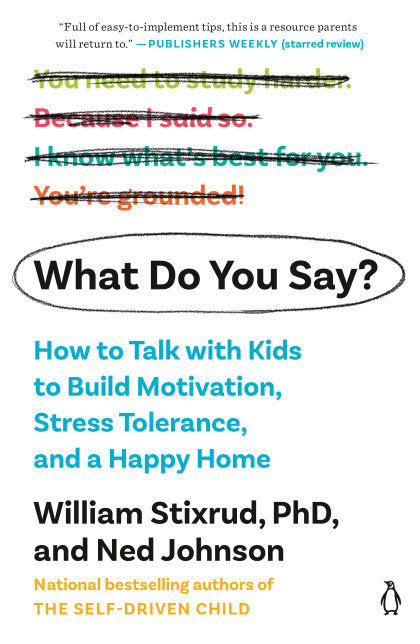
If you're a parent, you've had a moment--maybe many of them--when you've thought, "How did that conversation go so badly?" At some point after the sixth grade, the same kid who asked "why" non-stop at age four suddenly stops talking to you. And the conversations that you wish you could have--ones fueled by your desire to see your kid not just safe and healthy, but passionately engaged--suddenly feel nearly impossible to execute. The good news is that effective communication can be cultivated, learned, and taught. And as you get better at this, so will your kids.
William Stixrud, Ph.D., and Ned Johnson have 60 years combined experience talking to kids one-on-one, and the most common question they get when out speaking to parents and educators is: What do you say? While many adults understand the importance and power of the philosophies behind the books that dominate the parenting bestseller list, parents are often left wondering how to put those concepts into action. In What Do You Say?, Johnson and Stixrud show how to engage in respectful and effective dialogue, beginning with defining and demonstrating the basic principles of listening and speaking. Then they show new ways to handle specific, thorny topics of the sort that usually end in parent/kid standoffs: delivering constructive feedback to kids; discussing boundaries around technology; explaining sleep and their brains; the anxiety of current events; and family problem-solving. What Do You Say? is a manual and map that will immediately transform parents' ability to navigate complex terrain and train their minds and hearts to communicate ever more successfully.
STANDARD, PRIMARY, DM AND VARIANT COVERS
Standard and Primary covers are widely available through general retailers. They often have higher print runs and can be cheaper, especially during sales.
In contrast, Direct Market (DM) and variant covers are primarily sold in comic shops. DM editions tend to have more limited availability and may be more valuable to collectors.
The main differences lie in artwork style, availability, price, and collector appeal. Ultimately, the choice between standard and variant covers depends on personal preference, budget, and individual collecting goals.
PRODUCT TYPES
Comic book enthusiasts have various formats to choose from when collecting their favorite stories.
Here's a brief overview of the main types:
Omnibus
- Large, hardcover collections
- Usually contain complete runs or extensive story arcs
- Typically 800-1000+ pages
- Higher price point, often €100-€150
Oversized Hardcover (OHC)
- Similar dimensions to omnibus, but thinner
- Collect shorter runs or story arcs
- Usually 300-600 pages
- Priced between €30-€50
Hardcover (HC)
- Standard-sized hardcover books
- Collect 6-12 issues typically
- Similar dimensions to single issues, but with a hard cover
- Priced around €25-€35
Trade Paperback (TP)
- Softcover collections
- Standard comic book size
- Usually collect 4-6 issues
- Most affordable option, typically €15-€25
Other Formats
- Absolute Editions: Oversized, deluxe hardcovers (mainly DC Comics)
- Compendiums: Massive paperback collections
- Graphic Novels (OGN/GN): Original stories not previously released as single issues
The choice between these formats often depends on personal preference, budget, and collecting goals. Omnibus and OHC editions offer larger artwork and more content but at a higher price, while TPs provide a more affordable way to collect complete story arcs