

Knopf Doubleday Publishing Group
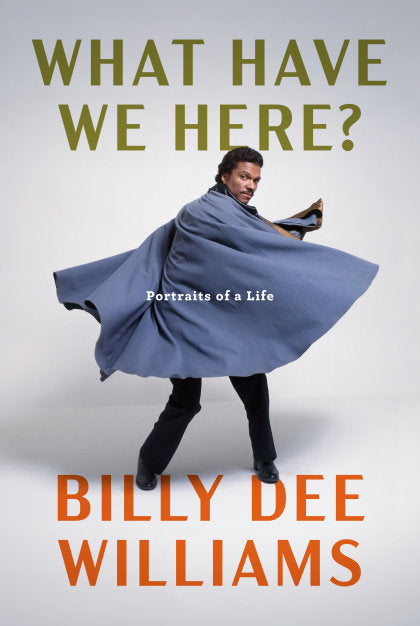
What Have We Here?
What Have We Here?
Couldn't load pickup availability
Collapsible content
ABOUT
“Effortlessly charming. . . [Williams] writes with clarity and intimacy, revealing the person behind the persona.” —Maya S. Cade, The New York Times Book Review
“The story of a legend, written by the legend himself! Impressive, inspiring, entertaining and endearing.” —J. J. Abrams
Billy Dee Williams was born in Harlem in 1937 and grew up in a household of love and sophistication. As a young boy, he made his stage debut working with Lotte Lenya in an Ira Gershwin/Kurt Weill production where Williams ended up feeding Lenya her lines. He studied painting, first at the High School of Music and Art, with fellow student Diahann Carroll, and then at the National Academy of Fine Art, before setting out to pursue acting with Herbert Berghoff, Stella Adler, and Sidney Poitier.
His first film role was in The Last Angry Man, the great Paul Muni’s final film. It was Muni who gave Billy the advice that sent him soaring as an actor, “You can play any character you want to play no matter who you are, no matter the way you look or the color of your skin.” And Williams writes, “I wanted to be anyone I wanted to be.”
He writes of landing the role of a lifetime: co-starring alongside James Caan in Brian’s Song, the made-for-television movie that was watched by an audience of more than fifty million people. Williams says it was “the kind of interracial love story America needed.”
And when, as the first Black character in the Star Wars universe, he became a true pop culture icon, playing Lando Calrissian in George Lucas’s The Empire Strikes Back (“What I presented on the screen people didn’t expect to see”). It was a role he reprised in the final film of the original trilogy, The Return of the Jedi, and in the recent sequel The Rise of Skywalker.
A legendary actor, in his own words, on all that has sustained and carried him through a lifetime of dreams and adventure.
STANDARD, PRIMARY, DM AND VARIANT COVERS
Standard and Primary covers are widely available through general retailers. They often have higher print runs and can be cheaper, especially during sales.
In contrast, Direct Market (DM) and variant covers are primarily sold in comic shops. DM editions tend to have more limited availability and may be more valuable to collectors.
The main differences lie in artwork style, availability, price, and collector appeal. Ultimately, the choice between standard and variant covers depends on personal preference, budget, and individual collecting goals.
PRODUCT TYPES
Comic book enthusiasts have various formats to choose from when collecting their favorite stories.
Here's a brief overview of the main types:
Omnibus
- Large, hardcover collections
- Usually contain complete runs or extensive story arcs
- Typically 800-1000+ pages
- Higher price point, often €100-€150
Oversized Hardcover (OHC)
- Similar dimensions to omnibus, but thinner
- Collect shorter runs or story arcs
- Usually 300-600 pages
- Priced between €30-€50
Hardcover (HC)
- Standard-sized hardcover books
- Collect 6-12 issues typically
- Similar dimensions to single issues, but with a hard cover
- Priced around €25-€35
Trade Paperback (TP)
- Softcover collections
- Standard comic book size
- Usually collect 4-6 issues
- Most affordable option, typically €15-€25
Other Formats
- Absolute Editions: Oversized, deluxe hardcovers (mainly DC Comics)
- Compendiums: Massive paperback collections
- Graphic Novels (OGN/GN): Original stories not previously released as single issues
The choice between these formats often depends on personal preference, budget, and collecting goals. Omnibus and OHC editions offer larger artwork and more content but at a higher price, while TPs provide a more affordable way to collect complete story arcs