

Random House Children's Books
What the World Eats
What the World Eats
Couldn't load pickup availability
Collapsible content
ABOUT
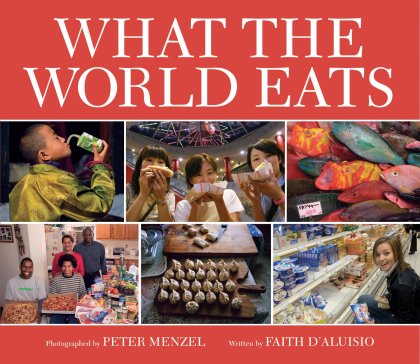
For the first time in history, more people are overfed than underfed. And while some people still have barely enough to eat, others overeat to the point of illness. To find out how mealtime is changing in real homes, authors Peter Menzel and Faith D’Aluisio visited families around the world to observe and photograph what they eat during the course of one week. They joined parents while they shopped at mega grocery stores and outdoor markets, and participated in a feast where a single goat was shared among many families. They watched moms making dinner in kitchens and over cooking fires, and they sat down to eat with twenty-five families in twenty-one countries--if you’re keeping track, that’s about 525 meals!
The foods dished up ranged from hunted seal and spit-roasted guinea pig to U.N.-rationed grains and gallons of Coca-Cola. As Peter and Faith ate and talked with families, they learned firsthand about food consumption around the world and its corresponding causes and effects. The resulting family portraits offer a fascinating glimpse into the cultural similarities and differences served on dinner plates around the globe.
This book has been selected as a Common Core State Standards Text Exemplar (Grades 2-3, Read-Aloud Informational Texts) in Appendix B.
STANDARD, PRIMARY, DM AND VARIANT COVERS
Standard and Primary covers are widely available through general retailers. They often have higher print runs and can be cheaper, especially during sales.
In contrast, Direct Market (DM) and variant covers are primarily sold in comic shops. DM editions tend to have more limited availability and may be more valuable to collectors.
The main differences lie in artwork style, availability, price, and collector appeal. Ultimately, the choice between standard and variant covers depends on personal preference, budget, and individual collecting goals.
PRODUCT TYPES
Comic book enthusiasts have various formats to choose from when collecting their favorite stories.
Here's a brief overview of the main types:
Omnibus
- Large, hardcover collections
- Usually contain complete runs or extensive story arcs
- Typically 800-1000+ pages
- Higher price point, often €100-€150
Oversized Hardcover (OHC)
- Similar dimensions to omnibus, but thinner
- Collect shorter runs or story arcs
- Usually 300-600 pages
- Priced between €30-€50
Hardcover (HC)
- Standard-sized hardcover books
- Collect 6-12 issues typically
- Similar dimensions to single issues, but with a hard cover
- Priced around €25-€35
Trade Paperback (TP)
- Softcover collections
- Standard comic book size
- Usually collect 4-6 issues
- Most affordable option, typically €15-€25
Other Formats
- Absolute Editions: Oversized, deluxe hardcovers (mainly DC Comics)
- Compendiums: Massive paperback collections
- Graphic Novels (OGN/GN): Original stories not previously released as single issues
The choice between these formats often depends on personal preference, budget, and collecting goals. Omnibus and OHC editions offer larger artwork and more content but at a higher price, while TPs provide a more affordable way to collect complete story arcs