

Berrett-Koehler Publishers
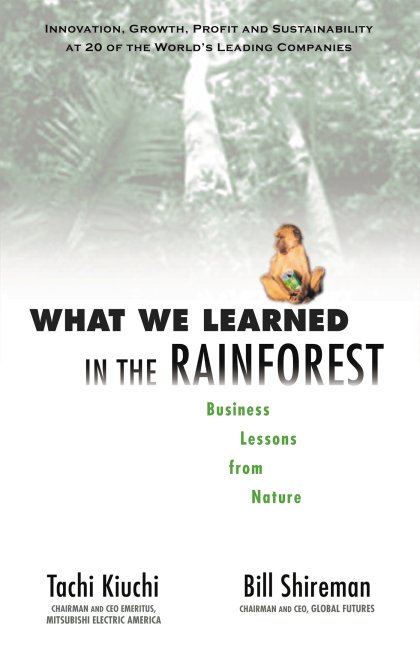
What We Learned in the Rainforest
What We Learned in the Rainforest
Couldn't load pickup availability
Collapsible content
ABOUT
With clear, direct language and dozens of real-world examples, Kiuchi and Shireman show how a company can become a complex living system that doesn't merely balance competing interests but truly integrates them. Examples from leading companies include:
How Coca-Cola CEO Doug Daft uses diversity to drive sales
How Intel founder Gordon Moore creates profit by design
How Bill Coors builds businesses on the theory that "all waste is lost profit"
How Shell profits as an industrial ecosystem
What Weyerhaeuser and activists learned from each other
How Dow earns 300% returns, and Dupont builds market share with eco-effectiveness, and more
This book shows that the old model of business-the machine model that pitted business against nature-is growing obsolete. In the emerging economy, businesses excel when they emulate what they once sought to conquer. They maximize performance as they become like nature, like a complex living system. By moving beyond the industrial machine model, and applying the dynamic principles of the rainforest instead, business can learn how to create more profit than ever, and to do so more sustainably.
Written by two would-be "arch enemies"-a hard-nosed CEO of a major corporation and a dedicated environmentalist-this book doesn't just balance competing interests, it integrates them into a truly revolutionary new paradigm. Kiuchi and Shireman present numerous real-world examples from leading companies-business strategies and management practices that maximize business performance by all measures: economic, social, and environmental. They illustrate the powerful business model provided by nature for driving innovation, increasing profit, spurring growth, and ensuring sustainability.
STANDARD, PRIMARY, DM AND VARIANT COVERS
Standard and Primary covers are widely available through general retailers. They often have higher print runs and can be cheaper, especially during sales.
In contrast, Direct Market (DM) and variant covers are primarily sold in comic shops. DM editions tend to have more limited availability and may be more valuable to collectors.
The main differences lie in artwork style, availability, price, and collector appeal. Ultimately, the choice between standard and variant covers depends on personal preference, budget, and individual collecting goals.
PRODUCT TYPES
Comic book enthusiasts have various formats to choose from when collecting their favorite stories.
Here's a brief overview of the main types:
Omnibus
- Large, hardcover collections
- Usually contain complete runs or extensive story arcs
- Typically 800-1000+ pages
- Higher price point, often €100-€150
Oversized Hardcover (OHC)
- Similar dimensions to omnibus, but thinner
- Collect shorter runs or story arcs
- Usually 300-600 pages
- Priced between €30-€50
Hardcover (HC)
- Standard-sized hardcover books
- Collect 6-12 issues typically
- Similar dimensions to single issues, but with a hard cover
- Priced around €25-€35
Trade Paperback (TP)
- Softcover collections
- Standard comic book size
- Usually collect 4-6 issues
- Most affordable option, typically €15-€25
Other Formats
- Absolute Editions: Oversized, deluxe hardcovers (mainly DC Comics)
- Compendiums: Massive paperback collections
- Graphic Novels (OGN/GN): Original stories not previously released as single issues
The choice between these formats often depends on personal preference, budget, and collecting goals. Omnibus and OHC editions offer larger artwork and more content but at a higher price, while TPs provide a more affordable way to collect complete story arcs