

Beacon Press
What Works in Community News
What Works in Community News
Couldn't load pickup availability
Collapsible content
ABOUT
A must-read for activists, entrepreneurs, and journalists who want to start local news outlets in their communities
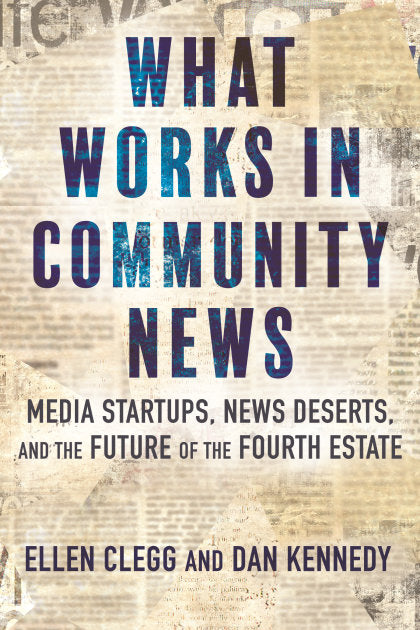
Local news is essential to democracy. Meaningful participation in civic life is impossible without it. However, local news is in crisis. According to one widely cited study, some 2,500 newspapers have closed over the last generation. And it is often marginalized communities of color who have been left without the day-to-day journalism they need to govern themselves in a democracy.
Veteran journalists Ellen Clegg and Dan Kennedy cut through the pessimism surrounding this issue, showing readers that new, innovative journalism models are popping up across the country to fill news deserts and empower communities. What Works in Community News examines more than a dozen of these projects, including:
- Sahan Journal, a digital publication dedicated to reporting on Minnesota’s immigrant and refugee communities;
- MLK50: Justice Through Journalism, a nonprofit news outlet in Memphis, TN, focused on poverty, power, and public policy;
- New Haven Independent / WNHH / La Voz Hispana de Connecticut, a digital news project that expanded its reach in the New Haven community through radio and a Spanish-language partnership;
- Storm Lake Times Pilot, a print newspaper in rural Iowa innovating with a hybrid for-profit/nonprofit model; and
- Texas Tribune, once a pioneering upstart, now one of the most well-known—and successful—digital newsrooms in the country.
Through a blend of on-the-ground reporting and interviews, Clegg and Kennedy show how these operations found seed money and support, and how they hired staff, forged their missions, and navigated challenges from the pandemic to police intimidation to stand as the last bastion of collective truth—and keep local news in local hands.
STANDARD, PRIMARY, DM AND VARIANT COVERS
Standard and Primary covers are widely available through general retailers. They often have higher print runs and can be cheaper, especially during sales.
In contrast, Direct Market (DM) and variant covers are primarily sold in comic shops. DM editions tend to have more limited availability and may be more valuable to collectors.
The main differences lie in artwork style, availability, price, and collector appeal. Ultimately, the choice between standard and variant covers depends on personal preference, budget, and individual collecting goals.
PRODUCT TYPES
Comic book enthusiasts have various formats to choose from when collecting their favorite stories.
Here's a brief overview of the main types:
Omnibus
- Large, hardcover collections
- Usually contain complete runs or extensive story arcs
- Typically 800-1000+ pages
- Higher price point, often €100-€150
Oversized Hardcover (OHC)
- Similar dimensions to omnibus, but thinner
- Collect shorter runs or story arcs
- Usually 300-600 pages
- Priced between €30-€50
Hardcover (HC)
- Standard-sized hardcover books
- Collect 6-12 issues typically
- Similar dimensions to single issues, but with a hard cover
- Priced around €25-€35
Trade Paperback (TP)
- Softcover collections
- Standard comic book size
- Usually collect 4-6 issues
- Most affordable option, typically €15-€25
Other Formats
- Absolute Editions: Oversized, deluxe hardcovers (mainly DC Comics)
- Compendiums: Massive paperback collections
- Graphic Novels (OGN/GN): Original stories not previously released as single issues
The choice between these formats often depends on personal preference, budget, and collecting goals. Omnibus and OHC editions offer larger artwork and more content but at a higher price, while TPs provide a more affordable way to collect complete story arcs