

Random House Publishing Group
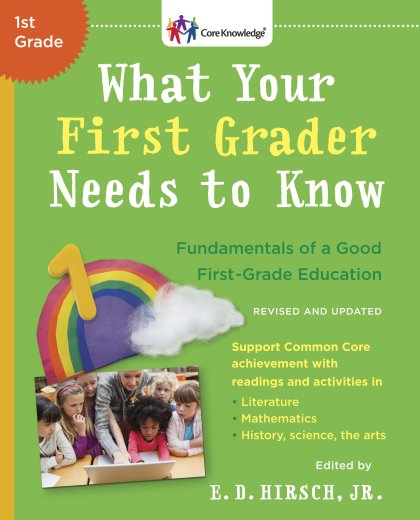
What Your First Grader Needs to Know (Revised and Updated)
What Your First Grader Needs to Know (Revised and Updated)
Couldn't load pickup availability
Collapsible content
ABOUT
What Your First Grader Needs to Know
What will your child be expected to learn in the first grade? How can you help him or her at home? How can teachers foster active, successful learning in the classroom? This book answers these all-important questions and more, offering the specific shared knowledge that hundreds of parents and teachers across the nation have agreed upon for American first graders. Featuring a new Introduction, filled with opportunities for reading aloud and fostering discussion, this first-grade volume of the acclaimed Core Knowledge Series presents the sort of knowledge and skills that should be at the core of a challenging first-grade education. Inside you’ll discover
• Favorite poems—old and new, such as “The Owl and the Pussycat,” “Wynken, Blynken, and Nod,” and “Thirty Days Hath September”
• Beloved stories—from many times and lands, including a selection of Aesop’s fables, “Hansel and Gretel,” “All Stories Are Anansi’s,” “The Tale of Peter Rabbit,” and more
• Familiar sayings and phrases—such as “Do unto others as you would have them do unto you” and “Practice makes perfect”
• World and American history and geography—take a trip down the Nile with King Tut and learn about the early days of our country, including the story of Jamestown, the Pilgrims, and the American Revolution
• Visual arts—fun activities plus full-color reproductions of masterworks by Leonardo da Vinci, Vincent van Gogh, Paul Cézanne, Georgia O’Keeffe, and others
• Music—engaging introductions to great composers and music, including classical music, opera, and jazz, as well as a selection of favorite children’s songs
• Math—a variety of activities to help your child learn to count, add and subtract, solve problems, recognize geometrical shapes and patterns, and learn about telling time
• Science—interesting discussions of living things and their habitats, the human body, the states of matter, electricity, our solar system, and what’s inside the earth, plus stories of famous scientists such as Thomas Edison and Louis Pasteur
STANDARD, PRIMARY, DM AND VARIANT COVERS
Standard and Primary covers are widely available through general retailers. They often have higher print runs and can be cheaper, especially during sales.
In contrast, Direct Market (DM) and variant covers are primarily sold in comic shops. DM editions tend to have more limited availability and may be more valuable to collectors.
The main differences lie in artwork style, availability, price, and collector appeal. Ultimately, the choice between standard and variant covers depends on personal preference, budget, and individual collecting goals.
PRODUCT TYPES
Comic book enthusiasts have various formats to choose from when collecting their favorite stories.
Here's a brief overview of the main types:
Omnibus
- Large, hardcover collections
- Usually contain complete runs or extensive story arcs
- Typically 800-1000+ pages
- Higher price point, often €100-€150
Oversized Hardcover (OHC)
- Similar dimensions to omnibus, but thinner
- Collect shorter runs or story arcs
- Usually 300-600 pages
- Priced between €30-€50
Hardcover (HC)
- Standard-sized hardcover books
- Collect 6-12 issues typically
- Similar dimensions to single issues, but with a hard cover
- Priced around €25-€35
Trade Paperback (TP)
- Softcover collections
- Standard comic book size
- Usually collect 4-6 issues
- Most affordable option, typically €15-€25
Other Formats
- Absolute Editions: Oversized, deluxe hardcovers (mainly DC Comics)
- Compendiums: Massive paperback collections
- Graphic Novels (OGN/GN): Original stories not previously released as single issues
The choice between these formats often depends on personal preference, budget, and collecting goals. Omnibus and OHC editions offer larger artwork and more content but at a higher price, while TPs provide a more affordable way to collect complete story arcs