

Random House Publishing Group
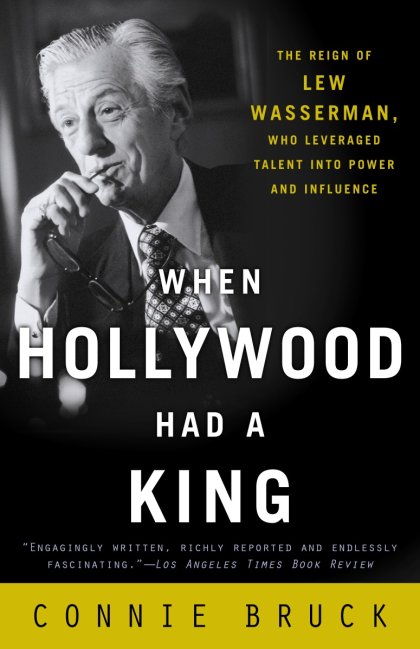
When Hollywood Had a King
When Hollywood Had a King
Couldn't load pickup availability
Collapsible content
ABOUT
The Music Corporation of America was founded in Chicago in 1924 by Dr. Jules Stein, an ophthalmologist with a gift for booking bands. Twelve years later, Stein moved his operations west to Beverly Hills and hired Lew Wasserman. From his meager beginnings as a movie-theater usher in Cleveland, Wasserman ultimately ascended to the post of president of MCA, and the company became the most powerful force in Hollywood, regarded with a mixture of fear and awe.
In his signature black suit and black knit tie, Was-serman took Hollywood by storm. He shifted the balance of power from the studios—which had seven-year contractual strangleholds on the stars—to the talent, who became profit partners. When an antitrust suit forced MCA’s evolution from talent agency to film- and television-production company, it was Wasserman who parlayed the control of a wide variety of entertainment and media products into a new type of Hollywood power base. There was only Washington left to conquer, and conquer it Wasserman did, quietly brokering alliances with Democratic and Republican administrations alike.
That Wasserman’s reach extended from the underworld to the White House only added to his mystique. Among his friends were Teamster boss Jimmy Hoffa, mob lawyer Sidney Korshak, and gangster Moe Dalitz—along with Presidents Johnson, Clinton, and especially Reagan, who enjoyed a particularly close and mutually beneficial relationship with Wasserman. He was equally intimate with Hollywood royalty, from Bette Davis and Jimmy Stewart to Steven Spielberg, who began his career at MCA and once described Wasserman’s eyeglasses as looking like two giant movie screens.
The history of MCA is really the history of a revolution. Lew Wasserman ushered in the Hollywood we know today. He is the link between the old-school moguls with their ironclad studio contracts and the new industry defined by multimedia conglomerates, power agents, multimillionaire actors, and profit sharing. In the hands of Connie Bruck, the story of Lew Wasserman’s rise to power takes on an almost Shakespearean scope. When Hollywood Had a King reveals the industry’s greatest untold story: how a stealthy, enterprising power broker became, for a time, Tinseltown’s absolute monarch.
STANDARD, PRIMARY, DM AND VARIANT COVERS
Standard and Primary covers are widely available through general retailers. They often have higher print runs and can be cheaper, especially during sales.
In contrast, Direct Market (DM) and variant covers are primarily sold in comic shops. DM editions tend to have more limited availability and may be more valuable to collectors.
The main differences lie in artwork style, availability, price, and collector appeal. Ultimately, the choice between standard and variant covers depends on personal preference, budget, and individual collecting goals.
PRODUCT TYPES
Comic book enthusiasts have various formats to choose from when collecting their favorite stories.
Here's a brief overview of the main types:
Omnibus
- Large, hardcover collections
- Usually contain complete runs or extensive story arcs
- Typically 800-1000+ pages
- Higher price point, often €100-€150
Oversized Hardcover (OHC)
- Similar dimensions to omnibus, but thinner
- Collect shorter runs or story arcs
- Usually 300-600 pages
- Priced between €30-€50
Hardcover (HC)
- Standard-sized hardcover books
- Collect 6-12 issues typically
- Similar dimensions to single issues, but with a hard cover
- Priced around €25-€35
Trade Paperback (TP)
- Softcover collections
- Standard comic book size
- Usually collect 4-6 issues
- Most affordable option, typically €15-€25
Other Formats
- Absolute Editions: Oversized, deluxe hardcovers (mainly DC Comics)
- Compendiums: Massive paperback collections
- Graphic Novels (OGN/GN): Original stories not previously released as single issues
The choice between these formats often depends on personal preference, budget, and collecting goals. Omnibus and OHC editions offer larger artwork and more content but at a higher price, while TPs provide a more affordable way to collect complete story arcs