

Random House Publishing Group
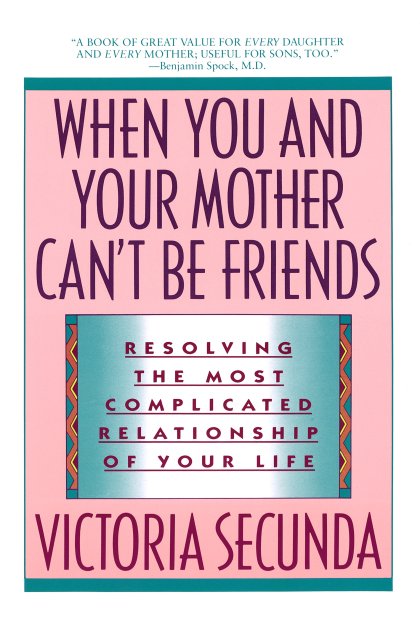
When You and Your Mother Can't Be Friends
When You and Your Mother Can't Be Friends
Couldn't load pickup availability
Collapsible content
ABOUT
From the Introduction:
The goal of this book is to help readers achieve that separation so that they can either find a way to be friends with their mothers, or at least recognize and accept that their mothers did the best they could—even if it wasn't “good enough”—and to stop blaming them. Among the issues to be covered:
• To understand how a daughter's attachment to her mother—more so than her relationship with her father—colors all her other relationships, and to analyze why it is more difficult for daughters than sons to separate from their mothers, as well as why daughters are more subject than sons to a mother's manipulation
• To recognize the difference between a healthy and a destructive mother-daughter connection, and to define clearly the “bad mommy,” in order to help readers who have trouble acknowledging their childhood losses to begin to comprehend them
• To conjugate what I call the “Bad Mommy Taboo”—why our culture is more eager to protect the sanctity of maternity than it is to protect emotionally abused daughters
• To describe the evolution of the "unpleasable" mother—in all likelihood, she was bereft of maternal love as a child—and to recognize the huge, and often poignant, stake she has in keeping her grown daughter dependent and off-balance
• To illustrate the consequent controlling behavior—in some cases, cloaked in fragility or good intentions—of such mothers, which falls into general patterns, including: the Doormat, the Critic, the Smotherer, the Avenger, the Deserter
• To understand that the daughter has a similar stake in either being a slave to or hating her mother—the two sides of her depen dency and immaturity
• To illustrate the responsive behavior—and survival mechanisms —of daughters, which is determined in part by such variables as birth rank, family history, and temperament, and which also falls into patterns, including: the Angel, the Superachiever, the Cipher, the Troublemaker, the Defector
• To show how to redefine the mother-daughter relationship, so that each can learn to see and accept the other as she is today, appreciating each other's good qualities and not being snared by the bad
• Finally, to demonstrate that a redefined relationship with one's mother—adult to adult—frees you from the past, whether that re definition ultimately results in real friendship, affectionate truce, or divorce.
STANDARD, PRIMARY, DM AND VARIANT COVERS
Standard and Primary covers are widely available through general retailers. They often have higher print runs and can be cheaper, especially during sales.
In contrast, Direct Market (DM) and variant covers are primarily sold in comic shops. DM editions tend to have more limited availability and may be more valuable to collectors.
The main differences lie in artwork style, availability, price, and collector appeal. Ultimately, the choice between standard and variant covers depends on personal preference, budget, and individual collecting goals.
PRODUCT TYPES
Comic book enthusiasts have various formats to choose from when collecting their favorite stories.
Here's a brief overview of the main types:
Omnibus
- Large, hardcover collections
- Usually contain complete runs or extensive story arcs
- Typically 800-1000+ pages
- Higher price point, often €100-€150
Oversized Hardcover (OHC)
- Similar dimensions to omnibus, but thinner
- Collect shorter runs or story arcs
- Usually 300-600 pages
- Priced between €30-€50
Hardcover (HC)
- Standard-sized hardcover books
- Collect 6-12 issues typically
- Similar dimensions to single issues, but with a hard cover
- Priced around €25-€35
Trade Paperback (TP)
- Softcover collections
- Standard comic book size
- Usually collect 4-6 issues
- Most affordable option, typically €15-€25
Other Formats
- Absolute Editions: Oversized, deluxe hardcovers (mainly DC Comics)
- Compendiums: Massive paperback collections
- Graphic Novels (OGN/GN): Original stories not previously released as single issues
The choice between these formats often depends on personal preference, budget, and collecting goals. Omnibus and OHC editions offer larger artwork and more content but at a higher price, while TPs provide a more affordable way to collect complete story arcs