

Knopf Doubleday Publishing Group
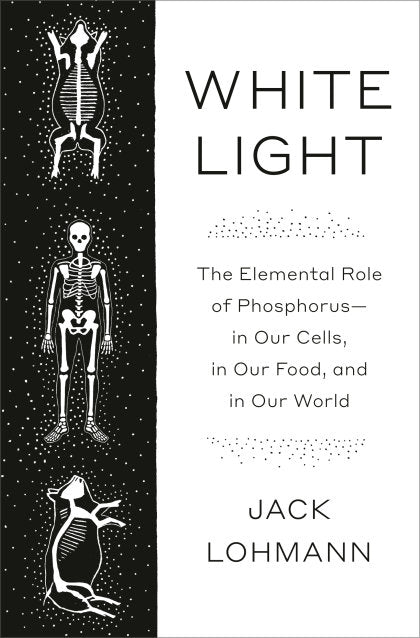
White Light
White Light
Couldn't load pickup availability
Collapsible content
ABOUT
A profound and poetic reflection on the cyclical nature of life, what happens when we break that cycle, and how to repair it—told through the fate of phosphorus
“There would be no life without constant death.” So begins Jack Lohmann’s remarkable debut, White Light, a mesmerizing swirl of ecology, geology, chemistry, history, agricultural science, investigative reporting, and the poetry of the natural world. Wherever life has roamed, its record is left in the sediment; over centuries, that dead matter is compacted into rock; and in that rock is phosphate—one phosphorus atom bonded to four oxygen atoms—life preserved in death, with all its surging force.
In 1842, when the naturalist John Stevens Henslow, Darwin’s beloved botany professor, discovered the potential of that rock as a fertilizer, little did he know his countrymen would soon be grinding up the bones of dead soldiers and mummified Egyptian cats to exploit their phosphate content. Little did he know he’d spawn a global mining industry that would change our diets, our lifestyles, and the face of the planet.
Lohmann guides us from Henslow’s Suffolk, where the phosphate fertilizer industry took root, to Bone Valley in Central Florida, where it has boomed alongside big ag—leaving wreckage like the Piney Point disaster in its wake—to far-flung Nauru, an island stripped of its life force by the ravenous young industry. We sift through the earth’s geological layers and eras, speak in depth with experts and locals, and explore our past relationship with sustainable farming—including in seventeenth-century Japan, when one could pay rent with their excrement—before we started wasting just as much phosphate as we mine.
Sui generis, filled with passion and rigorous reporting, White Light invites us to renew our broken relationship not just with the earth but with our own death—and the life it brings after us.
STANDARD, PRIMARY, DM AND VARIANT COVERS
Standard and Primary covers are widely available through general retailers. They often have higher print runs and can be cheaper, especially during sales.
In contrast, Direct Market (DM) and variant covers are primarily sold in comic shops. DM editions tend to have more limited availability and may be more valuable to collectors.
The main differences lie in artwork style, availability, price, and collector appeal. Ultimately, the choice between standard and variant covers depends on personal preference, budget, and individual collecting goals.
PRODUCT TYPES
Comic book enthusiasts have various formats to choose from when collecting their favorite stories.
Here's a brief overview of the main types:
Omnibus
- Large, hardcover collections
- Usually contain complete runs or extensive story arcs
- Typically 800-1000+ pages
- Higher price point, often €100-€150
Oversized Hardcover (OHC)
- Similar dimensions to omnibus, but thinner
- Collect shorter runs or story arcs
- Usually 300-600 pages
- Priced between €30-€50
Hardcover (HC)
- Standard-sized hardcover books
- Collect 6-12 issues typically
- Similar dimensions to single issues, but with a hard cover
- Priced around €25-€35
Trade Paperback (TP)
- Softcover collections
- Standard comic book size
- Usually collect 4-6 issues
- Most affordable option, typically €15-€25
Other Formats
- Absolute Editions: Oversized, deluxe hardcovers (mainly DC Comics)
- Compendiums: Massive paperback collections
- Graphic Novels (OGN/GN): Original stories not previously released as single issues
The choice between these formats often depends on personal preference, budget, and collecting goals. Omnibus and OHC editions offer larger artwork and more content but at a higher price, while TPs provide a more affordable way to collect complete story arcs