

Random House Publishing Group
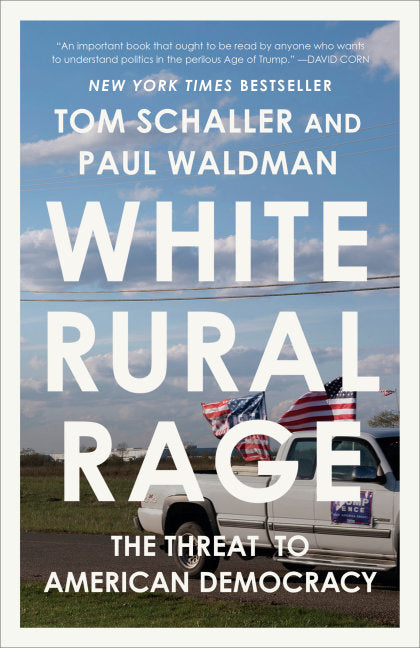
White Rural Rage
White Rural Rage
Couldn't load pickup availability
Collapsible content
ABOUT
“This is an important book that ought to be read by anyone who wants to understand politics in the perilous Age of Trump.”—David Corn, New York Times bestselling author of American Psychosis
White rural voters hold the greatest electoral sway of any demographic group in the United States, yet rural communities suffer from poor healthcare access, failing infrastructure, and severe manufacturing and farming job losses. Rural voters believe our nation has betrayed them, and to some degree, they’re right. In White Rural Rage, Tom Schaller and Paul Waldman explore why rural Whites have failed to reap the benefits from their outsize political power and why, as a result, they are the most likely group to abandon democratic norms and traditions. Their rage—stoked daily by Republican politicians and the conservative media—now poses an existential threat to the United States.
Schaller and Waldman show how vulnerable U.S. democracy has become to rural Whites who, despite legitimate grievances, are increasingly inclined to hold racist and xenophobic beliefs, to believe in conspiracy theories, to accept violence as a legitimate course of political action, and to exhibit antidemocratic tendencies. Rural White Americans’ attitude might best be described as “I love my country, but not our country,” Schaller and Waldman argue. This phenomenon is the patriot paradox of rural America: The citizens who take such pride in their patriotism are also the least likely to defend core American principles. And by stoking rural Whites’ anger rather than addressing the hard problems they face, conservative politicians and talking heads create a feedback loop of resentments that are undermining American democracy.
Schaller and Waldman provocatively critique both the structures that permit rural Whites’ disproportionate influence over American governance and the prospects for creating a pluralist, inclusive democracy that delivers policy solutions that benefit rural communities. They conclude with a political reimagining that offers a better future for both rural people and the rest of America.
STANDARD, PRIMARY, DM AND VARIANT COVERS
Standard and Primary covers are widely available through general retailers. They often have higher print runs and can be cheaper, especially during sales.
In contrast, Direct Market (DM) and variant covers are primarily sold in comic shops. DM editions tend to have more limited availability and may be more valuable to collectors.
The main differences lie in artwork style, availability, price, and collector appeal. Ultimately, the choice between standard and variant covers depends on personal preference, budget, and individual collecting goals.
PRODUCT TYPES
Comic book enthusiasts have various formats to choose from when collecting their favorite stories.
Here's a brief overview of the main types:
Omnibus
- Large, hardcover collections
- Usually contain complete runs or extensive story arcs
- Typically 800-1000+ pages
- Higher price point, often €100-€150
Oversized Hardcover (OHC)
- Similar dimensions to omnibus, but thinner
- Collect shorter runs or story arcs
- Usually 300-600 pages
- Priced between €30-€50
Hardcover (HC)
- Standard-sized hardcover books
- Collect 6-12 issues typically
- Similar dimensions to single issues, but with a hard cover
- Priced around €25-€35
Trade Paperback (TP)
- Softcover collections
- Standard comic book size
- Usually collect 4-6 issues
- Most affordable option, typically €15-€25
Other Formats
- Absolute Editions: Oversized, deluxe hardcovers (mainly DC Comics)
- Compendiums: Massive paperback collections
- Graphic Novels (OGN/GN): Original stories not previously released as single issues
The choice between these formats often depends on personal preference, budget, and collecting goals. Omnibus and OHC editions offer larger artwork and more content but at a higher price, while TPs provide a more affordable way to collect complete story arcs