

Penguin Publishing Group
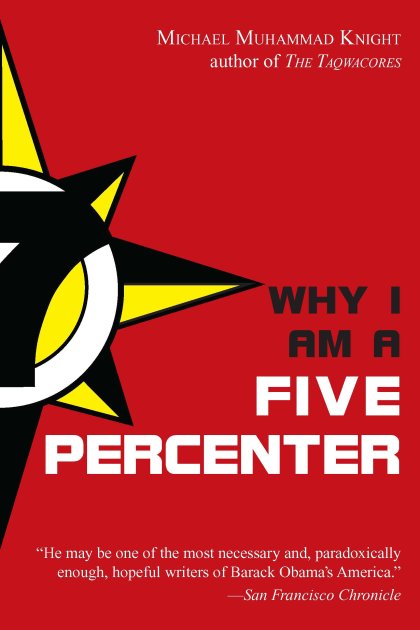
Why I Am a Five Percenter
Why I Am a Five Percenter
Couldn't load pickup availability
Collapsible content
ABOUT
Misrepresented in the media as a black parallel to the Hell's Angels, portrayed as everything from a vicious street gang to quasi- Islamic revolutionaries, The Five Percenters are a movement that began as a breakaway sect from the Nation of Islam (NOI) in 1960s Harlem and went on to impact the formation of hip-hop. References to Five Percent language and ideas are found in the lyrics of wide-ranging artists, such as Nas, Rakim, the Wu-Tang Clan, and even Jay-Z.
The Five Percenters are denounced by white America as racists, and orthodox Islam as heretics, for teaching that the black man is Allah. Michael Muhammad Knight ("the Hunter S. Thompson of Islamic literature" -The Guardian) has engaged this culture as both white and Muslim; and over the course of his relationship with The Five Percenters, his personal position changed from that of an outsider to an accepted participant with his own initiatory name (Azreal Wisdom). This has given him an intimate perch from which to understand and examine the controversial doctrines of this influential movement. In Why I Am a Five Percenter, Knight strips away years of sensationalism to offer a serious encounter with Five Percenter thought.
Encoded within Five Percent culture is a profound critique of organized religion, from which the movement derives its name: Only Five Percent can act as "poor righteous teachers" against the evil Ten Percent, the power structure which uses religion to deceive the Eighty- Five Percent, the "deaf, dumb, and blind" masses. Questioning his own relationship to the Five Percent, Knight directly confronts the community's most difficult teachings. In Why I Am a Five Percenter, Knight not only illuminates a thought system that must appear bizarre to outsiders, but he also brilliantly dissects the very issues of"insiders" and "outsiders," territory and ownership, as they relate to religion and privilege, and to our conditioned ideas about race.
STANDARD, PRIMARY, DM AND VARIANT COVERS
Standard and Primary covers are widely available through general retailers. They often have higher print runs and can be cheaper, especially during sales.
In contrast, Direct Market (DM) and variant covers are primarily sold in comic shops. DM editions tend to have more limited availability and may be more valuable to collectors.
The main differences lie in artwork style, availability, price, and collector appeal. Ultimately, the choice between standard and variant covers depends on personal preference, budget, and individual collecting goals.
PRODUCT TYPES
Comic book enthusiasts have various formats to choose from when collecting their favorite stories.
Here's a brief overview of the main types:
Omnibus
- Large, hardcover collections
- Usually contain complete runs or extensive story arcs
- Typically 800-1000+ pages
- Higher price point, often €100-€150
Oversized Hardcover (OHC)
- Similar dimensions to omnibus, but thinner
- Collect shorter runs or story arcs
- Usually 300-600 pages
- Priced between €30-€50
Hardcover (HC)
- Standard-sized hardcover books
- Collect 6-12 issues typically
- Similar dimensions to single issues, but with a hard cover
- Priced around €25-€35
Trade Paperback (TP)
- Softcover collections
- Standard comic book size
- Usually collect 4-6 issues
- Most affordable option, typically €15-€25
Other Formats
- Absolute Editions: Oversized, deluxe hardcovers (mainly DC Comics)
- Compendiums: Massive paperback collections
- Graphic Novels (OGN/GN): Original stories not previously released as single issues
The choice between these formats often depends on personal preference, budget, and collecting goals. Omnibus and OHC editions offer larger artwork and more content but at a higher price, while TPs provide a more affordable way to collect complete story arcs