

Penguin Publishing Group
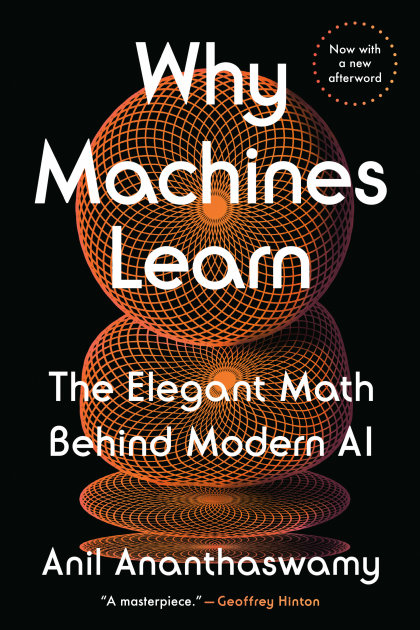
Why Machines Learn
Why Machines Learn
Couldn't load pickup availability
Collapsible content
ABOUT
Machine learning systems are making life-altering decisions for us: approving mortgage loans, determining whether a tumor is cancerous, or deciding if someone gets bail. They now influence developments and discoveries in chemistry, biology, and physics—the study of genomes, extrasolar planets, even the intricacies of quantum systems. And all this before large language models such as ChatGPT came on the scene.
We are living through a revolution in machine learning-powered AI that shows no signs of slowing down. This technology is based on relatively simple mathematical ideas, some of which go back centuries, including linear algebra and calculus, the stuff of seventeenth- and eighteenth-century mathematics. It took the birth and advancement of computer science and the kindling of 1990s computer chips designed for video games to ignite the explosion of AI that we see today. In this enlightening book, Anil Ananthaswamy explains the fundamental math behind machine learning, while suggesting intriguing links between artificial and natural intelligence. Might the same math underpin them both?
As Ananthaswamy resonantly concludes, to make safe and effective use of artificial intelligence, we need to understand its profound capabilities and limitations, the clues to which lie in the math that makes machine learning possible.
In a brand-new afterword exclusively in the paperback edition, Ananthaswamy dives into the Transformer architecture that makes large language models like ChatGPT possible and points to groundbreaking future directions enabled by the technology.
STANDARD, PRIMARY, DM AND VARIANT COVERS
Standard and Primary covers are widely available through general retailers. They often have higher print runs and can be cheaper, especially during sales.
In contrast, Direct Market (DM) and variant covers are primarily sold in comic shops. DM editions tend to have more limited availability and may be more valuable to collectors.
The main differences lie in artwork style, availability, price, and collector appeal. Ultimately, the choice between standard and variant covers depends on personal preference, budget, and individual collecting goals.
PRODUCT TYPES
Comic book enthusiasts have various formats to choose from when collecting their favorite stories.
Here's a brief overview of the main types:
Omnibus
- Large, hardcover collections
- Usually contain complete runs or extensive story arcs
- Typically 800-1000+ pages
- Higher price point, often €100-€150
Oversized Hardcover (OHC)
- Similar dimensions to omnibus, but thinner
- Collect shorter runs or story arcs
- Usually 300-600 pages
- Priced between €30-€50
Hardcover (HC)
- Standard-sized hardcover books
- Collect 6-12 issues typically
- Similar dimensions to single issues, but with a hard cover
- Priced around €25-€35
Trade Paperback (TP)
- Softcover collections
- Standard comic book size
- Usually collect 4-6 issues
- Most affordable option, typically €15-€25
Other Formats
- Absolute Editions: Oversized, deluxe hardcovers (mainly DC Comics)
- Compendiums: Massive paperback collections
- Graphic Novels (OGN/GN): Original stories not previously released as single issues
The choice between these formats often depends on personal preference, budget, and collecting goals. Omnibus and OHC editions offer larger artwork and more content but at a higher price, while TPs provide a more affordable way to collect complete story arcs