

Beacon Press
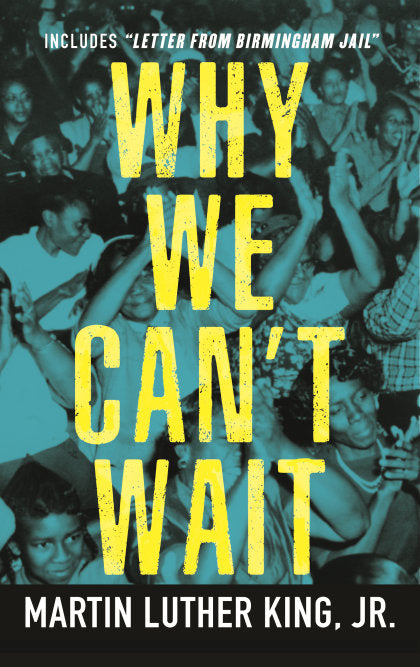
Why We Can't Wait
Why We Can't Wait
Couldn't load pickup availability
Collapsible content
ABOUT
On April 16, 1963, as the violent events of the Birmingham campaign unfolded in the city’s streets, Dr. Martin Luther King, Jr., composed a letter from his prison cell in response to local religious leaders’ criticism of the campaign. The resulting piece of extraordinary protest writing, “Letter from Birmingham Jail,” was widely circulated and published in numerous periodicals. After the conclusion of the campaign and the March on Washington for Jobs and Freedom in 1963, King further developed the ideas introduced in the letter in Why We Can’t Wait, which tells the story of African American activism in the spring and summer of 1963. During this time, Birmingham, Alabama, was perhaps the most racially segregated city in the United States, but the campaign launched by King, Fred Shuttlesworth, and others demonstrated to the world the power of nonviolent direct action.
Often applauded as King’s most incisive and eloquent book, Why We Can’t Wait recounts the Birmingham campaign in vivid detail, while underscoring why 1963 was such a crucial year for the civil rights movement. Disappointed by the slow pace of school desegregation and civil rights legislation, King observed that by 1963—during which the country celebrated the one-hundredth anniversary of the Emancipation Proclamation—Asia and Africa were “moving with jetlike speed toward gaining political independence but we still creep at a horse-and-buggy pace.”
King examines the history of the civil rights struggle, noting tasks that future generations must accomplish to bring about full equality, and asserts that African Americans have already waited over three centuries for civil rights and that it is time to be proactive: “For years now, I have heard the word ‘Wait!’ It rings in the ear of every Negro with piercing familiarity. This ‘Wait’ has almost always meant ‘Never.’ We must come to see, with one of our distinguished jurists, that ‘justice too long delayed is justice denied.’”
STANDARD, PRIMARY, DM AND VARIANT COVERS
Standard and Primary covers are widely available through general retailers. They often have higher print runs and can be cheaper, especially during sales.
In contrast, Direct Market (DM) and variant covers are primarily sold in comic shops. DM editions tend to have more limited availability and may be more valuable to collectors.
The main differences lie in artwork style, availability, price, and collector appeal. Ultimately, the choice between standard and variant covers depends on personal preference, budget, and individual collecting goals.
PRODUCT TYPES
Comic book enthusiasts have various formats to choose from when collecting their favorite stories.
Here's a brief overview of the main types:
Omnibus
- Large, hardcover collections
- Usually contain complete runs or extensive story arcs
- Typically 800-1000+ pages
- Higher price point, often €100-€150
Oversized Hardcover (OHC)
- Similar dimensions to omnibus, but thinner
- Collect shorter runs or story arcs
- Usually 300-600 pages
- Priced between €30-€50
Hardcover (HC)
- Standard-sized hardcover books
- Collect 6-12 issues typically
- Similar dimensions to single issues, but with a hard cover
- Priced around €25-€35
Trade Paperback (TP)
- Softcover collections
- Standard comic book size
- Usually collect 4-6 issues
- Most affordable option, typically €15-€25
Other Formats
- Absolute Editions: Oversized, deluxe hardcovers (mainly DC Comics)
- Compendiums: Massive paperback collections
- Graphic Novels (OGN/GN): Original stories not previously released as single issues
The choice between these formats often depends on personal preference, budget, and collecting goals. Omnibus and OHC editions offer larger artwork and more content but at a higher price, while TPs provide a more affordable way to collect complete story arcs