

Penguin Publishing Group
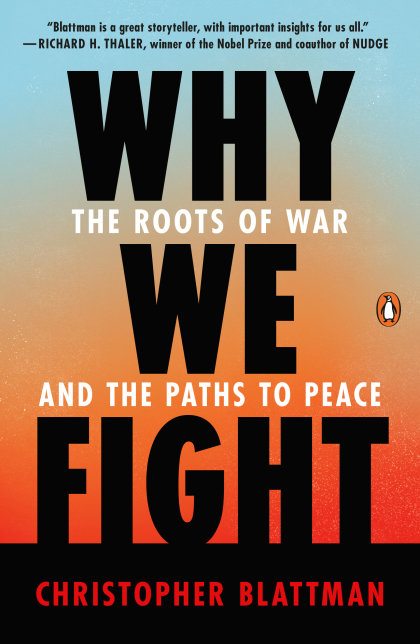
Why We Fight
Why We Fight
Couldn't load pickup availability
Collapsible content
ABOUT
“Engaging and profound, this deeply searching book explains the true origins of warfare, and it illustrates the ways that, despite some contrary appearances, human beings are capable of great goodness.”—Nicholas A. Christakis author of Blueprint: The Evolutionary Origins of a Good Society
Why did Russia attack Ukraine? Will China invade Taiwan and launch WWIII? Why has the number of civil wars reached their highest level in decades? Why are so many cities in the Americas plagued with violence? And finally, what can any of us do about it?
It feels like we’re surrounded by violence. Each conflict seems unique and insoluble. With a reason for every war and a war for every reason, what hope is there for peace? Fortunately, it’s simpler than that. Why We Fight boils down decades of economics, political science, psychology, and real-world interventions, giving us some counterintuitive answers to the question of war.
The first is that most of the time we don’t fight. Around the world, there are millions of hostile rivalries, yet only a fraction erupt into violence. Most enemies loathe one another in peace. The reason is simple: war is too costly to fight. It’s the worst way to settle our differences.
In those rare instances when fighting ensues, that means we have to ask ourselves: What kept rivals from the normal, grudging compromise? The answer is always the same: It’s because a society or its leaders ignored those costs of war, or were willing to pay them.
Why We Fight shows that there are just five ways this happens. From warring states to street gangs, ethnic groups and religious sects to political factions, Christopher Blattman shows that there are five reasons why violent conflict occasionally wins over compromise.
Through Blattman’s time studying Medellín, Chicago, Liberia, Northern Ireland, and more, we learn the common logics driving vainglorious monarchs, dictators, mobs, pilots, football hooligans, ancient peoples, and fanatics. Why We Fight shows that war isn’t a series of errors, accidents, and emotions gone awry. There are underlying strategic, ideological, and institutional forces that are too often overlooked.
So how to get to peace?
Blattman shows that societies are surprisingly good at interrupting and ending violence when they want to—even gangs do it. The best peacemakers tackle the five reasons, shifting incentives away from violence and getting rivals back to dealmaking. And they do so through tinkering, not transformation.
Realistic and optimistic, this is a book that lends new meaning to the adage “Give peace a chance.”
STANDARD, PRIMARY, DM AND VARIANT COVERS
Standard and Primary covers are widely available through general retailers. They often have higher print runs and can be cheaper, especially during sales.
In contrast, Direct Market (DM) and variant covers are primarily sold in comic shops. DM editions tend to have more limited availability and may be more valuable to collectors.
The main differences lie in artwork style, availability, price, and collector appeal. Ultimately, the choice between standard and variant covers depends on personal preference, budget, and individual collecting goals.
PRODUCT TYPES
Comic book enthusiasts have various formats to choose from when collecting their favorite stories.
Here's a brief overview of the main types:
Omnibus
- Large, hardcover collections
- Usually contain complete runs or extensive story arcs
- Typically 800-1000+ pages
- Higher price point, often €100-€150
Oversized Hardcover (OHC)
- Similar dimensions to omnibus, but thinner
- Collect shorter runs or story arcs
- Usually 300-600 pages
- Priced between €30-€50
Hardcover (HC)
- Standard-sized hardcover books
- Collect 6-12 issues typically
- Similar dimensions to single issues, but with a hard cover
- Priced around €25-€35
Trade Paperback (TP)
- Softcover collections
- Standard comic book size
- Usually collect 4-6 issues
- Most affordable option, typically €15-€25
Other Formats
- Absolute Editions: Oversized, deluxe hardcovers (mainly DC Comics)
- Compendiums: Massive paperback collections
- Graphic Novels (OGN/GN): Original stories not previously released as single issues
The choice between these formats often depends on personal preference, budget, and collecting goals. Omnibus and OHC editions offer larger artwork and more content but at a higher price, while TPs provide a more affordable way to collect complete story arcs