

Crown
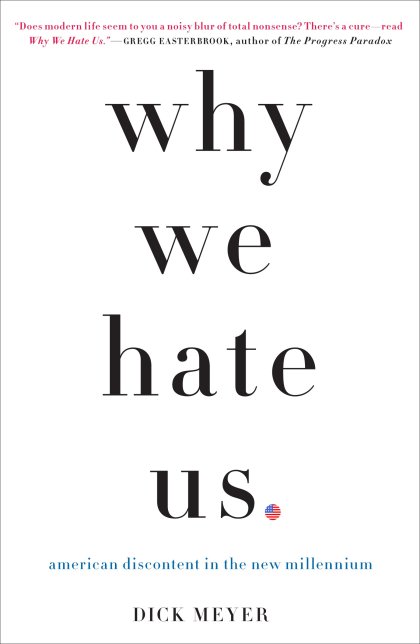
Why We Hate Us
Why We Hate Us
Couldn't load pickup availability
Collapsible content
ABOUT
Cell-phone talkers broadcasting the intimate details of their lives in public spaces
Worship of self-awareness, self-realization, and self-fulfillment
T-shirts that read, “Eat Me”
Facebook, MySpace, and kids being taught to market themselves
High-level cheating in business and sports
Reality television and the cosmetic surgery boom
Multinational corporations that claim, “We care about you.”
The decline of organic communities
A line of cosmetics called “S.L.U.T.”
The phony red state–blue state divide
The penetration of OmniMarketing into OmniMedia and the insinuation of both into every facet of our lives
You undoubtedly could add to the list with hardly a moment’s thought. In Why We Hate Us, Meyer absolutely nails America’s early-twenty-first-century mood disorder. He points out the most widespread carriers of the why-we-hate-us germs, including the belligerence of partisan politics that perverts our democracy, the decline of once common manners, the vulgarity of Hollywood entertainment, the superficiality and untrustworthiness of the news media, the cult of celebrity, and the disappearance of authentic neighborhoods and voluntary organizations (the kind that have actual meetings where one can hobnob instead of just clicking in an online contribution).
Meyer argues—with biting wit and observations that make you want to shout, “Yes! I hate that too!”—that when the social, spiritual, and political turmoil that followed the sixties collided with the technological and media revolution at the turn of the century, something inside us hit overload. American culture no longer reflects our own values. As a result, we are now morally and existentially tired, disoriented, anchorless, and defensive. We hate us and we wonder why.
Why We Hate Us reveals why we do and also offers a thoughtful and uplifting prescription for breaking out of our current morass and learning how to hate us less. It is a penetrating but always accessible Culture of Narcissism for a new generation, and it carries forward ideas that resounded with readers in bestsellers such as On Bullshit and Bowling Alone.
STANDARD, PRIMARY, DM AND VARIANT COVERS
Standard and Primary covers are widely available through general retailers. They often have higher print runs and can be cheaper, especially during sales.
In contrast, Direct Market (DM) and variant covers are primarily sold in comic shops. DM editions tend to have more limited availability and may be more valuable to collectors.
The main differences lie in artwork style, availability, price, and collector appeal. Ultimately, the choice between standard and variant covers depends on personal preference, budget, and individual collecting goals.
PRODUCT TYPES
Comic book enthusiasts have various formats to choose from when collecting their favorite stories.
Here's a brief overview of the main types:
Omnibus
- Large, hardcover collections
- Usually contain complete runs or extensive story arcs
- Typically 800-1000+ pages
- Higher price point, often €100-€150
Oversized Hardcover (OHC)
- Similar dimensions to omnibus, but thinner
- Collect shorter runs or story arcs
- Usually 300-600 pages
- Priced between €30-€50
Hardcover (HC)
- Standard-sized hardcover books
- Collect 6-12 issues typically
- Similar dimensions to single issues, but with a hard cover
- Priced around €25-€35
Trade Paperback (TP)
- Softcover collections
- Standard comic book size
- Usually collect 4-6 issues
- Most affordable option, typically €15-€25
Other Formats
- Absolute Editions: Oversized, deluxe hardcovers (mainly DC Comics)
- Compendiums: Massive paperback collections
- Graphic Novels (OGN/GN): Original stories not previously released as single issues
The choice between these formats often depends on personal preference, budget, and collecting goals. Omnibus and OHC editions offer larger artwork and more content but at a higher price, while TPs provide a more affordable way to collect complete story arcs