

Penguin Publishing Group
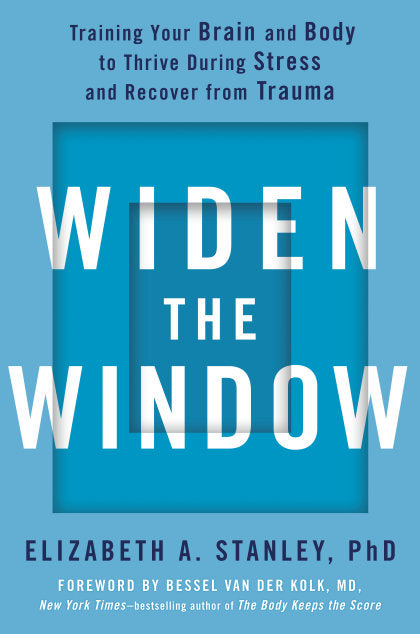
Widen the Window
Widen the Window
Couldn't load pickup availability
Collapsible content
ABOUT
--from the foreword by Bessel van der Kolk
A pioneering researcher gives us a new understanding of stress and trauma, as well as the tools to heal and thrive
Stress is our internal response to an experience that our brain perceives as threatening or challenging. Trauma is our response to an experience in which we feel powerless or lacking agency. Until now, researchers have treated these conditions as different, but they actually lie along a continuum. Dr. Elizabeth Stanley explains the significance of this continuum, how it affects our resilience in the face of challenge, and why an event that's stressful for one person can be traumatizing for another.
This groundbreaking book examines the cultural norms that impede resilience in America, especially our collective tendency to disconnect stress from its potentially extreme consequences and override our need to recover. It explains the science of how to direct our attention to perform under stress and recover from trauma.
With training, we can access agency, even in extreme-stress environments. In fact, any maladaptive behavior or response conditioned through stress or trauma can, with intentionality and understanding, be reconditioned and healed. The key is to use strategies that access not just the thinking brain but also the survival brain.
By directing our attention in particular ways, we can widen the window within which our thinking brain and survival brain work together cooperatively. When we use awareness to regulate our biology this way, we can access our best, uniquely human qualities: our compassion, courage, curiosity, creativity, and connection with others. By building our resilience, we can train ourselves to make wise decisions and access choice--even during times of incredible stress, uncertainty, and change.
With stories from men and women Dr. Stanley has trained in settings as varied as military bases, healthcare facilities, and Capitol Hill, as well as her own striking experiences with stress and trauma, she gives readers hands-on strategies they can use themselves, whether they want to perform under pressure or heal from traumatic experience, while at the same time pointing our understanding in a new direction.
STANDARD, PRIMARY, DM AND VARIANT COVERS
Standard and Primary covers are widely available through general retailers. They often have higher print runs and can be cheaper, especially during sales.
In contrast, Direct Market (DM) and variant covers are primarily sold in comic shops. DM editions tend to have more limited availability and may be more valuable to collectors.
The main differences lie in artwork style, availability, price, and collector appeal. Ultimately, the choice between standard and variant covers depends on personal preference, budget, and individual collecting goals.
PRODUCT TYPES
Comic book enthusiasts have various formats to choose from when collecting their favorite stories.
Here's a brief overview of the main types:
Omnibus
- Large, hardcover collections
- Usually contain complete runs or extensive story arcs
- Typically 800-1000+ pages
- Higher price point, often €100-€150
Oversized Hardcover (OHC)
- Similar dimensions to omnibus, but thinner
- Collect shorter runs or story arcs
- Usually 300-600 pages
- Priced between €30-€50
Hardcover (HC)
- Standard-sized hardcover books
- Collect 6-12 issues typically
- Similar dimensions to single issues, but with a hard cover
- Priced around €25-€35
Trade Paperback (TP)
- Softcover collections
- Standard comic book size
- Usually collect 4-6 issues
- Most affordable option, typically €15-€25
Other Formats
- Absolute Editions: Oversized, deluxe hardcovers (mainly DC Comics)
- Compendiums: Massive paperback collections
- Graphic Novels (OGN/GN): Original stories not previously released as single issues
The choice between these formats often depends on personal preference, budget, and collecting goals. Omnibus and OHC editions offer larger artwork and more content but at a higher price, while TPs provide a more affordable way to collect complete story arcs