

Library of America
William Faulkner: Stories (LOA #375)
William Faulkner: Stories (LOA #375)
Couldn't load pickup availability
Collapsible content
ABOUT
Faulkner called the short story “the most demanding form after poetry” and wrote to an editor that “even to a collection of short stories, form, integration, is as important as to a novel—an entity of its own, single, set for one pitch, contrapuntal in integration, toward one end, one finale.” Faulkner was a major practitioner of the short story form and keenly sensitive to its aesthetic demands.
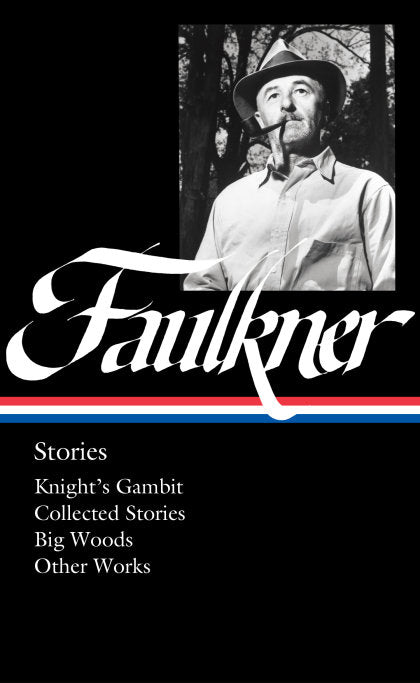
The Library of America edition of the collected writings of William Faulkner culminates with this volume presenting all the stories the author gathered for his book collections, in newly edited and authoritative texts. This is Faulkner as he was meant to be read.
Faulkner’s monumental Collected Stories (1950) presented the author’s first two collections, These Thirteen (1931) and Doctor Martino (1934), along with seventeen new stories, all carefully selected and arranged by the author; Knight’s Gambit (1949) collected six stories about attorney Gavin Stevens’ detective work; and in Big Woods (1955) Faulkner gathered four hunting stories connected with interstitial material. This volume presents these three collections as carefully arranged by Faulkner, with new authoritative and corrected texts that best represent Faulkner’s intentions for the stories. Here are such well-known stories as “A Rose for Emily,” “Barn Burning,” and “A Bear Hunt,” as well as some of his most poetic--“Carcassone”—and less known, such as “The Tall Men,” “Elly,” and “Uncle Willy.”
Also included are Faulkner’s stories “The Hound” (collected in Doctor Martino but omitted by the author from Collected Stories), “Spotted Horses,” Faulkner’s fictionalized autobiographical essay “Mississippi,” as well as his Nobel Prize acceptance speech and helpful explanatory notes by Faulkner scholar Theresa M. Towner.
STANDARD, PRIMARY, DM AND VARIANT COVERS
Standard and Primary covers are widely available through general retailers. They often have higher print runs and can be cheaper, especially during sales.
In contrast, Direct Market (DM) and variant covers are primarily sold in comic shops. DM editions tend to have more limited availability and may be more valuable to collectors.
The main differences lie in artwork style, availability, price, and collector appeal. Ultimately, the choice between standard and variant covers depends on personal preference, budget, and individual collecting goals.
PRODUCT TYPES
Comic book enthusiasts have various formats to choose from when collecting their favorite stories.
Here's a brief overview of the main types:
Omnibus
- Large, hardcover collections
- Usually contain complete runs or extensive story arcs
- Typically 800-1000+ pages
- Higher price point, often €100-€150
Oversized Hardcover (OHC)
- Similar dimensions to omnibus, but thinner
- Collect shorter runs or story arcs
- Usually 300-600 pages
- Priced between €30-€50
Hardcover (HC)
- Standard-sized hardcover books
- Collect 6-12 issues typically
- Similar dimensions to single issues, but with a hard cover
- Priced around €25-€35
Trade Paperback (TP)
- Softcover collections
- Standard comic book size
- Usually collect 4-6 issues
- Most affordable option, typically €15-€25
Other Formats
- Absolute Editions: Oversized, deluxe hardcovers (mainly DC Comics)
- Compendiums: Massive paperback collections
- Graphic Novels (OGN/GN): Original stories not previously released as single issues
The choice between these formats often depends on personal preference, budget, and collecting goals. Omnibus and OHC editions offer larger artwork and more content but at a higher price, while TPs provide a more affordable way to collect complete story arcs