

Crown
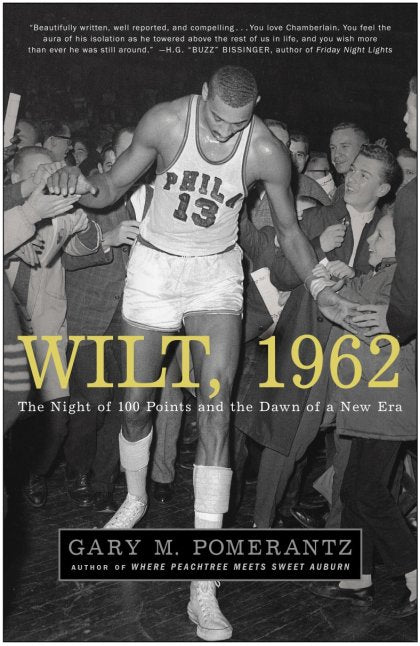
Wilt, 1962
Wilt, 1962
Couldn't load pickup availability
Collapsible content
ABOUT
As historic and revolutionary as the achievement was, it remains shrouded in myth. The game was not televised; no New York sportswriters showed up; and a fourteen-year-old local boy ran onto the court when Chamberlain scored his hundredth point, shook his hand, and then ran off with the basketball. In telling the story of this remarkable night, author Gary M. Pomerantz brings to life a lost world of American sports.
In 1962, the National Basketball Association, stepchild to the college game, was searching for its identity. Its teams were mostly white, the number of black players limited by an unspoken quota. Games were played in drafty, half-filled arenas, and the players traveled on buses and trains, telling tall tales, playing cards, and sometimes reading Joyce. Into this scene stepped the unprecedented Wilt Chamberlain: strong and quick-witted, voluble and enigmatic, a seven-footer who played with a colossal will and a dancer’s grace. That strength, will, grace, and mystery were never more in focus than on March 2, 1962. Pomerantz tracked down Knicks and Philadelphia Warriors, fans, journalists, team officials, other NBA stars of the era, and basketball historians, conducting more than 250 interviews in all, to recreate in painstaking detail the game that announced the Dipper’s greatness. He brings us to Hershey, Pennsylvania, a sweet-seeming model of the gentle, homogeneous small-town America that was fast becoming anachronistic. We see the fans and players, alternately fascinated and confused by Wilt, drawn anxiously into the spectacle. Pomerantz portrays the other legendary figures in this story: the Warriors’ elegant coach Frank McGuire; the beloved, if rumpled, team owner Eddie Gottlieb; and the irreverent p.a. announcer Dave “the Zink” Zinkoff, who handed out free salamis courtside.
At the heart of the book is the self-made Chamberlain, a romantic cosmopolitan who owned a nightclub in Harlem and shrugged off segregation with a bebop cool but harbored every slight deep in his psyche. March 2, 1962, presented the awesome sight of Wilt Chamberlain imposing himself on a world that would diminish him. Wilt, 1962 is not only the dramatic story of a singular basketball game but a meditation on small towns, midcentury America, and one of the most intriguing figures in the pantheon of sports heroes.
Also available as a Random House AudioBook
STANDARD, PRIMARY, DM AND VARIANT COVERS
Standard and Primary covers are widely available through general retailers. They often have higher print runs and can be cheaper, especially during sales.
In contrast, Direct Market (DM) and variant covers are primarily sold in comic shops. DM editions tend to have more limited availability and may be more valuable to collectors.
The main differences lie in artwork style, availability, price, and collector appeal. Ultimately, the choice between standard and variant covers depends on personal preference, budget, and individual collecting goals.
PRODUCT TYPES
Comic book enthusiasts have various formats to choose from when collecting their favorite stories.
Here's a brief overview of the main types:
Omnibus
- Large, hardcover collections
- Usually contain complete runs or extensive story arcs
- Typically 800-1000+ pages
- Higher price point, often €100-€150
Oversized Hardcover (OHC)
- Similar dimensions to omnibus, but thinner
- Collect shorter runs or story arcs
- Usually 300-600 pages
- Priced between €30-€50
Hardcover (HC)
- Standard-sized hardcover books
- Collect 6-12 issues typically
- Similar dimensions to single issues, but with a hard cover
- Priced around €25-€35
Trade Paperback (TP)
- Softcover collections
- Standard comic book size
- Usually collect 4-6 issues
- Most affordable option, typically €15-€25
Other Formats
- Absolute Editions: Oversized, deluxe hardcovers (mainly DC Comics)
- Compendiums: Massive paperback collections
- Graphic Novels (OGN/GN): Original stories not previously released as single issues
The choice between these formats often depends on personal preference, budget, and collecting goals. Omnibus and OHC editions offer larger artwork and more content but at a higher price, while TPs provide a more affordable way to collect complete story arcs