

Crown
Wisdom at Work
Wisdom at Work
Couldn't load pickup availability
Collapsible content
ABOUT
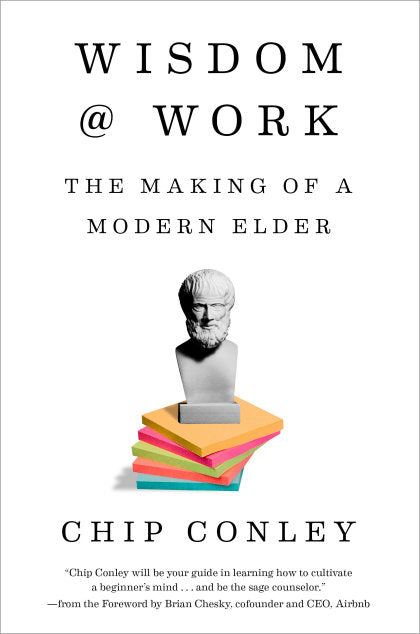
At age 52, after selling the company he founded and ran as CEO for 24 years, rebel boutique hotelier Chip Conley was looking at an open horizon in midlife. Then he received a call from the young founders of Airbnb, asking him to help grow their disruptive start-up into a global hospitality giant. He had the industry experience, but Conley was lacking in the digital fluency of his 20-something colleagues. He didn't write code, or have an Uber or Lyft app on his phone, was twice the age of the average Airbnb employee, and would be reporting to a CEO young enough to be his son. Conley quickly discovered that while he'd been hired as a teacher and mentor, he was also in many ways a student and intern. What emerged is the secret to thriving as a mid-life worker: learning to marry wisdom and experience with curiosity, a beginner's mind, and a willingness to evolve, all hallmarks of the "Modern Elder."
In a world that venerates the new, bright, and shiny, many of us are left feeling invisible, undervalued, and threatened by the "digital natives" nipping at our heels. But Conley argues that experience is on the brink of a comeback. Because at a time when power is shifting younger, companies are finally waking up to the value of the humility, emotional intelligence, and wisdom that come with age. And while digital skills might have only the shelf life of the latest fad or gadget, the human skills that mid-career workers possess--like good judgment, specialized knowledge, and the ability to collaborate and coach - never expire.
Part manifesto and part playbook, Wisdom@Work ignites an urgent conversation about ageism in the workplace, calling on us to treat age as we would other type of diversity. In the process, Conley liberates the term "elder" from the stigma of "elderly," and inspires us to embrace wisdom as a path to growing whole, not old. Whether you've been forced to make a mid-career change, are choosing to work past retirement age, or are struggling to keep up with the millennials rising up the ranks, Wisdom@Work will help you write your next chapter.
STANDARD, PRIMARY, DM AND VARIANT COVERS
Standard and Primary covers are widely available through general retailers. They often have higher print runs and can be cheaper, especially during sales.
In contrast, Direct Market (DM) and variant covers are primarily sold in comic shops. DM editions tend to have more limited availability and may be more valuable to collectors.
The main differences lie in artwork style, availability, price, and collector appeal. Ultimately, the choice between standard and variant covers depends on personal preference, budget, and individual collecting goals.
PRODUCT TYPES
Comic book enthusiasts have various formats to choose from when collecting their favorite stories.
Here's a brief overview of the main types:
Omnibus
- Large, hardcover collections
- Usually contain complete runs or extensive story arcs
- Typically 800-1000+ pages
- Higher price point, often €100-€150
Oversized Hardcover (OHC)
- Similar dimensions to omnibus, but thinner
- Collect shorter runs or story arcs
- Usually 300-600 pages
- Priced between €30-€50
Hardcover (HC)
- Standard-sized hardcover books
- Collect 6-12 issues typically
- Similar dimensions to single issues, but with a hard cover
- Priced around €25-€35
Trade Paperback (TP)
- Softcover collections
- Standard comic book size
- Usually collect 4-6 issues
- Most affordable option, typically €15-€25
Other Formats
- Absolute Editions: Oversized, deluxe hardcovers (mainly DC Comics)
- Compendiums: Massive paperback collections
- Graphic Novels (OGN/GN): Original stories not previously released as single issues
The choice between these formats often depends on personal preference, budget, and collecting goals. Omnibus and OHC editions offer larger artwork and more content but at a higher price, while TPs provide a more affordable way to collect complete story arcs