

Beacon Press
With Her Fist Raised
With Her Fist Raised
Couldn't load pickup availability
Collapsible content
ABOUT
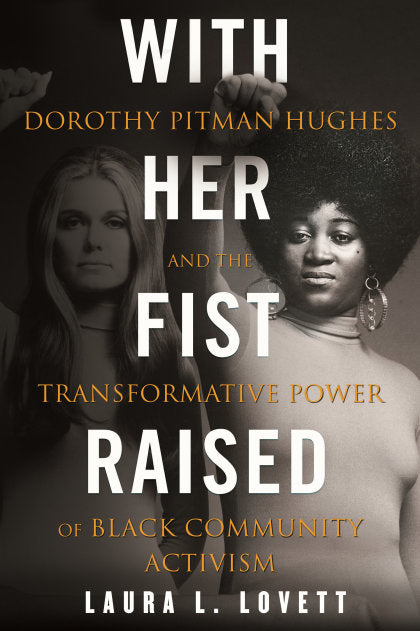
Dorothy Pitman Hughes was a transformative community organizer in New York City in the 1970s who shared the stage with Gloria Steinem for 5 years, captivating audiences around the country. After leaving rural Georgia in the 1950s, she moved to New York, determined to fight for civil rights and equality. Historian Laura L. Lovett traces Hughes’s journey as she became a powerhouse activist, responding to the needs of her community and building a platform for its empowerment. She created lasting change by revitalizing her West Side neighborhood, which was subjected to racial discrimination, with nonexistent childcare and substandard housing, where poverty, drug use, a lack of job training, and the effects of the Vietnam War were evident. Hughes created a high-quality childcare center that also offered job training, adult education classes, a Youth Action corps, housing assistance, and food resources.
Hughes’s realization that her neighborhood could be revitalized by actively engaging and including the community was prescient and is startlingly relevant. As her stature grew to a national level, Hughes spent several years traversing the country with Steinem and educating people about feminism, childcare, and race. She moved to Harlem in the 1970s to counter gentrification and bought the franchise to the Miss Greater New York City pageant to demonstrate that Black was beautiful. She also opened an office supply store and became a powerful voice for Black women entrepreneurs and Black-owned businesses. Throughout every phase of her life, Hughes understood the transformative power of activism for Black communities.
With expert research, which includes Hughes’s own accounts of her life, With Her Fist Raised is the necessary biography of a pivotal figure in women’s history and Black feminism whose story will finally be told.
STANDARD, PRIMARY, DM AND VARIANT COVERS
Standard and Primary covers are widely available through general retailers. They often have higher print runs and can be cheaper, especially during sales.
In contrast, Direct Market (DM) and variant covers are primarily sold in comic shops. DM editions tend to have more limited availability and may be more valuable to collectors.
The main differences lie in artwork style, availability, price, and collector appeal. Ultimately, the choice between standard and variant covers depends on personal preference, budget, and individual collecting goals.
PRODUCT TYPES
Comic book enthusiasts have various formats to choose from when collecting their favorite stories.
Here's a brief overview of the main types:
Omnibus
- Large, hardcover collections
- Usually contain complete runs or extensive story arcs
- Typically 800-1000+ pages
- Higher price point, often €100-€150
Oversized Hardcover (OHC)
- Similar dimensions to omnibus, but thinner
- Collect shorter runs or story arcs
- Usually 300-600 pages
- Priced between €30-€50
Hardcover (HC)
- Standard-sized hardcover books
- Collect 6-12 issues typically
- Similar dimensions to single issues, but with a hard cover
- Priced around €25-€35
Trade Paperback (TP)
- Softcover collections
- Standard comic book size
- Usually collect 4-6 issues
- Most affordable option, typically €15-€25
Other Formats
- Absolute Editions: Oversized, deluxe hardcovers (mainly DC Comics)
- Compendiums: Massive paperback collections
- Graphic Novels (OGN/GN): Original stories not previously released as single issues
The choice between these formats often depends on personal preference, budget, and collecting goals. Omnibus and OHC editions offer larger artwork and more content but at a higher price, while TPs provide a more affordable way to collect complete story arcs