

Beacon Press
Women Warriors
Women Warriors
Couldn't load pickup availability
Collapsible content
ABOUT
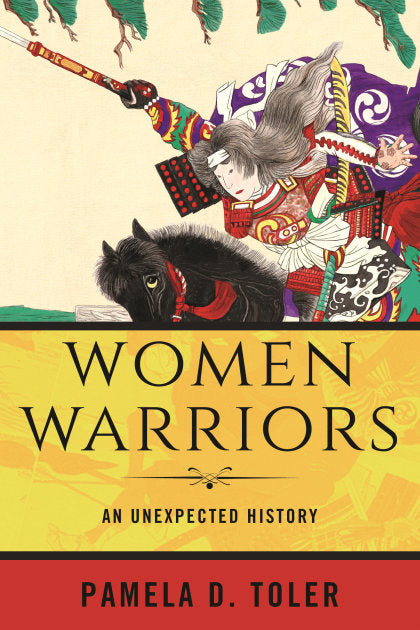
The woman warrior is always cast as an anomaly—Joan of Arc, not GI Jane. But women, it turns out, have always gone to war. In this fascinating and lively world history, Pamela Toler not only introduces us to women who took up arms, she also shows why they did it and what happened when they stepped out of their traditional female roles to take on other identities.
These are the stories of women who fought because they wanted to, because they had to, or because they could. Among the warriors you’ll meet are:
* Tomyris, ruler of the Massagetae, who killed Cyrus the Great of Persia when he sought to invade her lands
* The West African ruler Amina of Hausa, who led her warriors in a campaign of territorial expansion for more than 30 years
* Boudica, who led the Celtic tribes of Britain into a massive rebellion against the Roman Empire to avenge the rapes of her daughters
* The Trung sisters, Trung Trac and Trung Nhi, who led an untrained army of 80,000 troops to drive the Chinese empire out of Vietnam
* The Joshigun, a group of 30 combat-trained Japanese women who fought against the forces of the Meiji emperor in the late 19th century
* Lakshmi Bai, Rani of Jhansi, who was regarded as the “bravest and best” military leader in the 1857 Indian Mutiny against British rule
* Maria Bochkareva, who commanded Russia’s first all-female battalion—the First Women’s Battalion of Death—during WWII
* Buffalo Calf Road Woman, the Cheyenne warrior who knocked General Custer off his horse at the Battle of Little Bighorn
* Juana Azurduy de Padilla, a mestiza warrior who fought in at least 16 major battles against colonizers of Latin America and who is a national hero in Bolivia and Argentina today
* And many more spanning from ancient times through the 20th century.
By considering the ways in which their presence has been erased from history, Toler reveals that women have always fought—not in spite of being women but because they are women.
STANDARD, PRIMARY, DM AND VARIANT COVERS
Standard and Primary covers are widely available through general retailers. They often have higher print runs and can be cheaper, especially during sales.
In contrast, Direct Market (DM) and variant covers are primarily sold in comic shops. DM editions tend to have more limited availability and may be more valuable to collectors.
The main differences lie in artwork style, availability, price, and collector appeal. Ultimately, the choice between standard and variant covers depends on personal preference, budget, and individual collecting goals.
PRODUCT TYPES
Comic book enthusiasts have various formats to choose from when collecting their favorite stories.
Here's a brief overview of the main types:
Omnibus
- Large, hardcover collections
- Usually contain complete runs or extensive story arcs
- Typically 800-1000+ pages
- Higher price point, often €100-€150
Oversized Hardcover (OHC)
- Similar dimensions to omnibus, but thinner
- Collect shorter runs or story arcs
- Usually 300-600 pages
- Priced between €30-€50
Hardcover (HC)
- Standard-sized hardcover books
- Collect 6-12 issues typically
- Similar dimensions to single issues, but with a hard cover
- Priced around €25-€35
Trade Paperback (TP)
- Softcover collections
- Standard comic book size
- Usually collect 4-6 issues
- Most affordable option, typically €15-€25
Other Formats
- Absolute Editions: Oversized, deluxe hardcovers (mainly DC Comics)
- Compendiums: Massive paperback collections
- Graphic Novels (OGN/GN): Original stories not previously released as single issues
The choice between these formats often depends on personal preference, budget, and collecting goals. Omnibus and OHC editions offer larger artwork and more content but at a higher price, while TPs provide a more affordable way to collect complete story arcs