

Knopf Doubleday Publishing Group
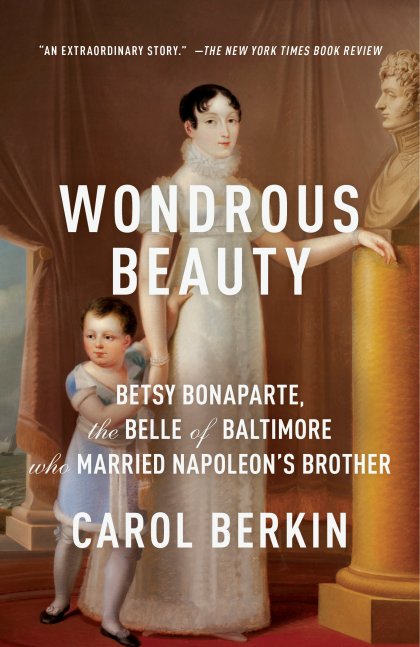
Wondrous Beauty
Wondrous Beauty
Couldn't load pickup availability
Collapsible content
ABOUT
In Wondrous Beauty, Carol Berkin tells the story of this audacious, outsized life. We see how the news of the union infuriated Napoleon and resulted in his banning the then pregnant Betsy Bonaparte from disembarking in any European port, offering his brother the threat of remaining married to that “American girl” and forfeiting all wealth and power—or renouncing her, marrying a woman of Napoleon’s choice, and reaping the benefits.
Jérôme ended the marriage posthaste and was made king of Westphalia; Betsy fled to England, gave birth to her son and only child, Jérôme’s namesake, and was embraced by the English press, who boasted that their nation had opened its arms to the cruelly abandoned young wife.
Berkin writes that this naïve, headstrong American girl returned to Baltimore a wiser, independent woman, refusing to seek social redemption or a return to obscurity through a quiet marriage to a member of Baltimore’s merchant class. Instead she was courted by many, indifferent to all, and initiated a dangerous game of politics—a battle for a pension from Napoleon—which she won: her pension from the French government arrived each month until Napoleon’s exile.
Using Betsy Bonaparte’s extensive letters, the author makes clear that the “belle of Baltimore” disdained America’s obsession with moneymaking, its growing ethos of democracy, and its rigid gender roles that confined women to the parlor and the nursery; that she sought instead a European society where women created salons devoted to intellectual life—where she was embraced by many who took into their confidence, such as Madame de Staël, Madame Récamier, the aging Marquise de Villette (goddaughter of Voltaire), among others—and where aristocracy, based on birth and breeding rather than commerce, dominated society.
Wondrous Beauty is a riveting portrait of a woman torn between two worlds, unable to find peace in either—one a provincial, convention-bound new America; the other a sophisticated, extravagant Old World Europe that embraced freedoms, a Europe ultimately swallowed up by decadence and idleness.
A stunning revelation of an extraordinary age.
STANDARD, PRIMARY, DM AND VARIANT COVERS
Standard and Primary covers are widely available through general retailers. They often have higher print runs and can be cheaper, especially during sales.
In contrast, Direct Market (DM) and variant covers are primarily sold in comic shops. DM editions tend to have more limited availability and may be more valuable to collectors.
The main differences lie in artwork style, availability, price, and collector appeal. Ultimately, the choice between standard and variant covers depends on personal preference, budget, and individual collecting goals.
PRODUCT TYPES
Comic book enthusiasts have various formats to choose from when collecting their favorite stories.
Here's a brief overview of the main types:
Omnibus
- Large, hardcover collections
- Usually contain complete runs or extensive story arcs
- Typically 800-1000+ pages
- Higher price point, often €100-€150
Oversized Hardcover (OHC)
- Similar dimensions to omnibus, but thinner
- Collect shorter runs or story arcs
- Usually 300-600 pages
- Priced between €30-€50
Hardcover (HC)
- Standard-sized hardcover books
- Collect 6-12 issues typically
- Similar dimensions to single issues, but with a hard cover
- Priced around €25-€35
Trade Paperback (TP)
- Softcover collections
- Standard comic book size
- Usually collect 4-6 issues
- Most affordable option, typically €15-€25
Other Formats
- Absolute Editions: Oversized, deluxe hardcovers (mainly DC Comics)
- Compendiums: Massive paperback collections
- Graphic Novels (OGN/GN): Original stories not previously released as single issues
The choice between these formats often depends on personal preference, budget, and collecting goals. Omnibus and OHC editions offer larger artwork and more content but at a higher price, while TPs provide a more affordable way to collect complete story arcs