

Beacon Press
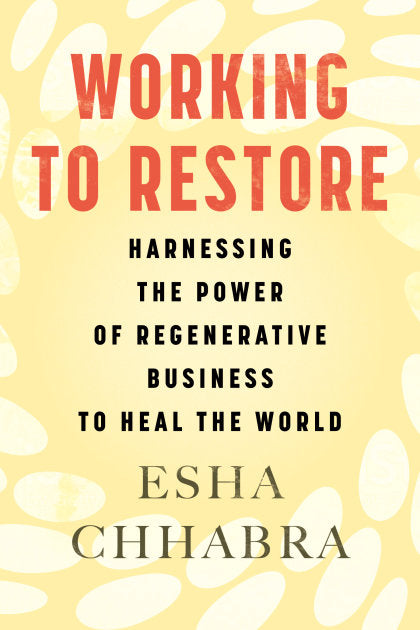
Working to Restore
Working to Restore
Couldn't load pickup availability
Collapsible content
ABOUT
Dispatches from the regenerative landscape, where pioneering entrepreneurs use their businesses as catalysts of change to go beyond sustainability and solve social and environmental problems
Political upheaval and social turmoil have peeled back the glitzy layers of capitalism to reveal an uncomfortable truth: historically, businesses have sourced materials from remote corners of the globe and moved millions of people and tons of cargo around the clock—all in the name of profit. Yet many of today’s startups are rewriting the rules of business: how it’s done, by whom, and, most importantly, for what purpose. Journalist Esha Chhabra draws on her decades of reporting to explore not only the “feel good, do good” factors of these restorative enterprises but also the nuanced realities and promise of regenerative business operations.
Working to Restore examines revolutionary approaches in nine areas: agriculture, waste, supply chain, inclusivity for the collective good, women in the workforce, travel, health, energy, and finance. The companies profiled are solving global issues: promoting responsible production and consumption, creating equitable opportunities for all, encouraging climate action, and more. Chhabra highlights how their work moves beyond the greenwashed idea of “sustainability” into a new era of regeneration and restoration.
We meet and learn from people like:
- Marius Smit, founder of Plastic Whale, the first company to build boats entirely out of plastic waste removed from our oceans and waterways
- Sébastien Kopp and François-Ghislain Morillion, cofounders of Veja, a shoe brand whose mission it is to make the most ecologically sensitive shoes possible
- Konrad Brits at Falcon Coffees, a trading company leading the way with a “collaborative supply chain” by investing in the local farmers who grow and harvest coffee beans
- “Chief Toaster” Rob Wilson and Tristram Stuart at Toast Ale, who partner with Wold Top Yorkshire Brewery to repurpose surplus bread and produce an award-winning IPA
- Scott Fry and Martha Butler of Loving Earth, a supply chain company that sources cacao from indigenous communities and brings their people and practices to the forefront
Working to Restore highlights our most innovative entrepreneurs yet, those who understand that we cannot expect to create radical change if we try to “sustain” a system that has long been broken. Instead, their efforts of restoration and regeneration should be used as a model for other forward-thinking enterprises. Inspiring and engaging, this book shows it is possible for a business to thrive while living its mission and how the rules can be rewritten to put both the planet and its global citizens at the center.
STANDARD, PRIMARY, DM AND VARIANT COVERS
Standard and Primary covers are widely available through general retailers. They often have higher print runs and can be cheaper, especially during sales.
In contrast, Direct Market (DM) and variant covers are primarily sold in comic shops. DM editions tend to have more limited availability and may be more valuable to collectors.
The main differences lie in artwork style, availability, price, and collector appeal. Ultimately, the choice between standard and variant covers depends on personal preference, budget, and individual collecting goals.
PRODUCT TYPES
Comic book enthusiasts have various formats to choose from when collecting their favorite stories.
Here's a brief overview of the main types:
Omnibus
- Large, hardcover collections
- Usually contain complete runs or extensive story arcs
- Typically 800-1000+ pages
- Higher price point, often €100-€150
Oversized Hardcover (OHC)
- Similar dimensions to omnibus, but thinner
- Collect shorter runs or story arcs
- Usually 300-600 pages
- Priced between €30-€50
Hardcover (HC)
- Standard-sized hardcover books
- Collect 6-12 issues typically
- Similar dimensions to single issues, but with a hard cover
- Priced around €25-€35
Trade Paperback (TP)
- Softcover collections
- Standard comic book size
- Usually collect 4-6 issues
- Most affordable option, typically €15-€25
Other Formats
- Absolute Editions: Oversized, deluxe hardcovers (mainly DC Comics)
- Compendiums: Massive paperback collections
- Graphic Novels (OGN/GN): Original stories not previously released as single issues
The choice between these formats often depends on personal preference, budget, and collecting goals. Omnibus and OHC editions offer larger artwork and more content but at a higher price, while TPs provide a more affordable way to collect complete story arcs