

Penguin Publishing Group
World Order
World Order
Couldn't load pickup availability
Collapsible content
ABOUT
"An astute analysis that illuminates many of today's critical international issues." —Kirkus Reviews
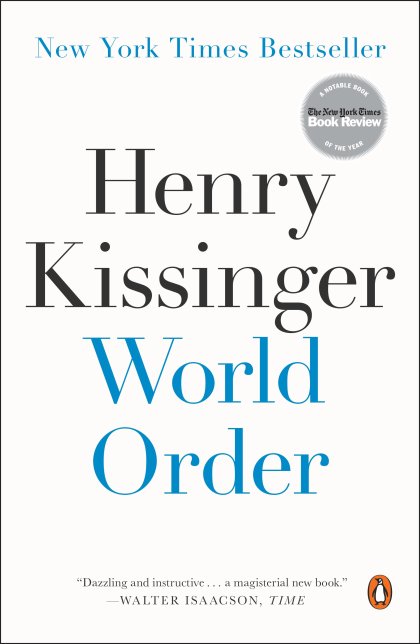
Henry Kissinger offers in World Order a deep meditation on the roots of international harmony and global disorder. Drawing on his experience as one of the foremost statesmen of the modern era—advising presidents, traveling the world, observing and shaping the central foreign policy events of recent decades—Kissinger now reveals his analysis of the ultimate challenge for the twenty-first century: how to build a shared international order in a world of divergent historical perspectives, violent conflict, proliferating technology, and ideological extremism.
There has never been a true “world order,” Kissinger observes. For most of history, civilizations defined their own concepts of order. Each considered itself the center of the world and envisioned its distinct principles as universally relevant. China conceived of a global cultural hierarchy with the emperor at its pinnacle. In Europe, Rome imagined itself surrounded by barbarians; when Rome fragmented, European peoples refined a concept of an equilibrium of sovereign states and sought to export it across the world. Islam, in its early centuries, considered itself the world’s sole legitimate political unit, destined to expand indefinitely until the world was brought into harmony by religious principles. The United States was born of a conviction about the universal applicability of democracy—a conviction that has guided its policies ever since.
Now international affairs take place on a global basis, and these historical concepts of world order are meeting. Every region participates in questions of high policy in every other, often instantaneously. Yet there is no consensus among the major actors about the rules and limits guiding this process or its ultimate destination. The result is mounting tension.
Grounded in Kissinger’s deep study of history and his experience as national security advisor and secretary of state, World Order guides readers through crucial episodes in recent world history. Kissinger offers a unique glimpse into the inner deliberations of the Nixon administration’s negotiations with Hanoi over the end of the Vietnam War, as well as Ronald Reagan’s tense debates with Soviet Premier Gorbachev in Reykjavík. He offers compelling insights into the future of U.S.–China relations and the evolution of the European Union, and he examines lessons of the conflicts in Iraq and Afghanistan. Taking readers from his analysis of nuclear negotiations with Iran through the West’s response to the Arab Spring and tensions with Russia over Ukraine, World Order anchors Kissinger’s historical analysis in the decisive events of our time.
Provocative and articulate, blending historical insight with geopolitical prognostication, World Order is a unique work that could come only from a lifelong policy maker and diplomat. Kissinger is also the author of On China.
STANDARD, PRIMARY, DM AND VARIANT COVERS
Standard and Primary covers are widely available through general retailers. They often have higher print runs and can be cheaper, especially during sales.
In contrast, Direct Market (DM) and variant covers are primarily sold in comic shops. DM editions tend to have more limited availability and may be more valuable to collectors.
The main differences lie in artwork style, availability, price, and collector appeal. Ultimately, the choice between standard and variant covers depends on personal preference, budget, and individual collecting goals.
PRODUCT TYPES
Comic book enthusiasts have various formats to choose from when collecting their favorite stories.
Here's a brief overview of the main types:
Omnibus
- Large, hardcover collections
- Usually contain complete runs or extensive story arcs
- Typically 800-1000+ pages
- Higher price point, often €100-€150
Oversized Hardcover (OHC)
- Similar dimensions to omnibus, but thinner
- Collect shorter runs or story arcs
- Usually 300-600 pages
- Priced between €30-€50
Hardcover (HC)
- Standard-sized hardcover books
- Collect 6-12 issues typically
- Similar dimensions to single issues, but with a hard cover
- Priced around €25-€35
Trade Paperback (TP)
- Softcover collections
- Standard comic book size
- Usually collect 4-6 issues
- Most affordable option, typically €15-€25
Other Formats
- Absolute Editions: Oversized, deluxe hardcovers (mainly DC Comics)
- Compendiums: Massive paperback collections
- Graphic Novels (OGN/GN): Original stories not previously released as single issues
The choice between these formats often depends on personal preference, budget, and collecting goals. Omnibus and OHC editions offer larger artwork and more content but at a higher price, while TPs provide a more affordable way to collect complete story arcs