

Library of America
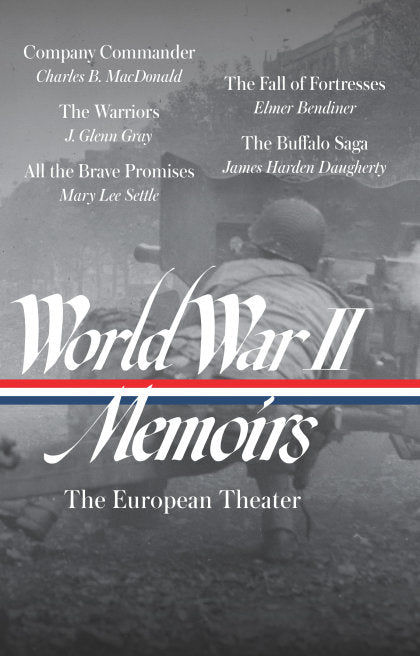
World War II Memoirs: The European Theater (LOA #385)
World War II Memoirs: The European Theater (LOA #385)
Couldn't load pickup availability
Collapsible content
ABOUT
"The emotional environment of warfare has always been compelling," writes J. Glenn Gray in his incomparable World War II memoir and mediation, The Warriors. "Reflection and calm reasoning are alien to it." The struggle to make sense of the experience of war, to find some meaning in the savagry and senseless destruction, animates the five brilliant and unforgettable memoirs gathered here.
- Company Commander (1947), by Charles B. MacDonald, describes with startling immediacy and candor the “cold, dirty, rough, frightened, miserable” life of the infantryman and company commander from the aftermath of D-Day in September 1944 through the war's terrifying final days.
- The Warriors (1959), by J. Glenn Gray, a counterintelligence officer who served in Italy, France, and Germany and a scholar with a PhD. in philosophy, is a sensitive and revelatory meditation on the nature of war and its effects on both soldiers and civilians, interspliced with his letters, journals, and wartime memories.
- All the Brave Promises (1966) is novelist Mary Lee Settle’s memoir of her year as an airfield radio operator in the Royal Air Force. Settle brilliantly evokes both the working-class culture of the Women’s Auxiliary Air Force’s “other ranks” and the petty and demeaning regimentation inherent in military life.
- The Fall of Fortresses (1980), by former B-17 navigator Elmer Bendiner, vividly recalls the fear and excitement he experienced flying bomber missions deep into Germany in 1943 without fighter escort.
- The Buffalo Saga (2009) is James Harden Daugherty’s heartfelt account of his frontline service as a Black soldier in the 92nd Infantry Division, as he fights the Germans, endures the harsh Italian winter, and confronts the racism of his own army.
This deluxe Library of America volume includes full-color endpaper maps of the European Theater, an eight-page photo insert, an introduction by West Point professor Elizabeth D. Samet, and detailed notes.
STANDARD, PRIMARY, DM AND VARIANT COVERS
Standard and Primary covers are widely available through general retailers. They often have higher print runs and can be cheaper, especially during sales.
In contrast, Direct Market (DM) and variant covers are primarily sold in comic shops. DM editions tend to have more limited availability and may be more valuable to collectors.
The main differences lie in artwork style, availability, price, and collector appeal. Ultimately, the choice between standard and variant covers depends on personal preference, budget, and individual collecting goals.
PRODUCT TYPES
Comic book enthusiasts have various formats to choose from when collecting their favorite stories.
Here's a brief overview of the main types:
Omnibus
- Large, hardcover collections
- Usually contain complete runs or extensive story arcs
- Typically 800-1000+ pages
- Higher price point, often €100-€150
Oversized Hardcover (OHC)
- Similar dimensions to omnibus, but thinner
- Collect shorter runs or story arcs
- Usually 300-600 pages
- Priced between €30-€50
Hardcover (HC)
- Standard-sized hardcover books
- Collect 6-12 issues typically
- Similar dimensions to single issues, but with a hard cover
- Priced around €25-€35
Trade Paperback (TP)
- Softcover collections
- Standard comic book size
- Usually collect 4-6 issues
- Most affordable option, typically €15-€25
Other Formats
- Absolute Editions: Oversized, deluxe hardcovers (mainly DC Comics)
- Compendiums: Massive paperback collections
- Graphic Novels (OGN/GN): Original stories not previously released as single issues
The choice between these formats often depends on personal preference, budget, and collecting goals. Omnibus and OHC editions offer larger artwork and more content but at a higher price, while TPs provide a more affordable way to collect complete story arcs