

Knopf Doubleday Publishing Group
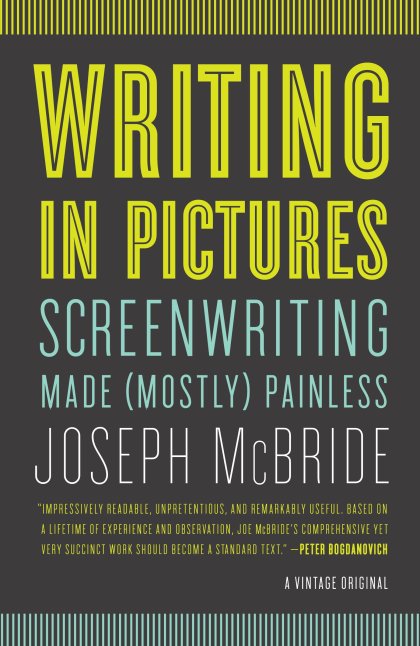
Writing in Pictures
Writing in Pictures
Couldn't load pickup availability
Collapsible content
ABOUT
Seasoned screenwriter and writing teacher Joseph McBride breaks down the process into a series of easy, approachable tasks, focusing on literary adaptation as the best way to learn the basics and avoiding the usual formulaic approach. With its wealth of useful tips, along with colorful insights from master screenwriters past and present, this book is invaluable for anyone who wants to learn the craft of screen storytelling.
CONTENTS
Introduction: Who Needs Another Book on Screenwriting?
Part I: Storytelling
1: So Why Write Screenplays?
2: What Is Screenwriting?
3: Stories: What They Are and How to Find Them
4: Ten Tips for the Road Ahead
Part II: Adaptation
5: Breaking the Back of the Book: or, The Art of Adaptation
STEP 1: THE STORY OUTLINE
6: Research and Development
STEP 2: THE ADAPTATION OUTLINE
7: The Elements of Screenwriting
STEP 3: THE CHARACTER BIOGRAPHY
8: Exploring Your Story and How to Tell It
STEP 4: THE TREATMENT
Part III: Production
9: Who Needs Formatting?
10: Actors Are Your Medium
11: Dialogue as Action
STEP 5: THE STEP OUTLINE
12: The Final Script
13: Epilogue: Breaking into Professional Filmmaking
Appendix A: The Basic Steps in the Screenwriting Process
Appendix B: “To Build A Fire” by Jack London
Selected Bibliography
Acknowledgments
Index
STANDARD, PRIMARY, DM AND VARIANT COVERS
Standard and Primary covers are widely available through general retailers. They often have higher print runs and can be cheaper, especially during sales.
In contrast, Direct Market (DM) and variant covers are primarily sold in comic shops. DM editions tend to have more limited availability and may be more valuable to collectors.
The main differences lie in artwork style, availability, price, and collector appeal. Ultimately, the choice between standard and variant covers depends on personal preference, budget, and individual collecting goals.
PRODUCT TYPES
Comic book enthusiasts have various formats to choose from when collecting their favorite stories.
Here's a brief overview of the main types:
Omnibus
- Large, hardcover collections
- Usually contain complete runs or extensive story arcs
- Typically 800-1000+ pages
- Higher price point, often €100-€150
Oversized Hardcover (OHC)
- Similar dimensions to omnibus, but thinner
- Collect shorter runs or story arcs
- Usually 300-600 pages
- Priced between €30-€50
Hardcover (HC)
- Standard-sized hardcover books
- Collect 6-12 issues typically
- Similar dimensions to single issues, but with a hard cover
- Priced around €25-€35
Trade Paperback (TP)
- Softcover collections
- Standard comic book size
- Usually collect 4-6 issues
- Most affordable option, typically €15-€25
Other Formats
- Absolute Editions: Oversized, deluxe hardcovers (mainly DC Comics)
- Compendiums: Massive paperback collections
- Graphic Novels (OGN/GN): Original stories not previously released as single issues
The choice between these formats often depends on personal preference, budget, and collecting goals. Omnibus and OHC editions offer larger artwork and more content but at a higher price, while TPs provide a more affordable way to collect complete story arcs