

Random House Publishing Group
You're Wearing That?
You're Wearing That?
Couldn't load pickup availability
Collapsible content
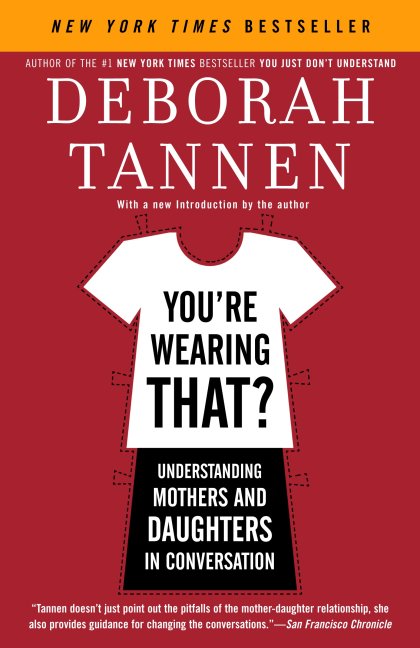
ABOUT
It was Tannen who first showed us that men and women speak different languages. Mothers and daughters speak the same language–but still often misunderstand each other, as they struggle to find the right balance between closeness and independence. Both mothers and daughters want to be seen for who they are, but tend to see the other as falling short of who she should be. Each overestimates the other’s power and underestimates her own.
Why do daughters complain that their mothers always criticize, while mothers feel hurt that their daughters shut them out? Why do mothers and daughters critique each other on the Big Three–hair, clothes, and weight–while longing for approval and understanding? And why do they scrutinize each other for reflections of themselves?
Deborah Tannen answers these and many other questions as she explains why a remark that would be harmless coming from anyone else can cause an explosion when it comes from your mother or your daughter. She examines every aspect of this complex dynamic, from the dark side that can shadow a woman throughout her life, to the new technologies like e-mail and instant messaging that are transforming mother-daughter communication. Most important, she helps mothers and daughters understand each other, the key to improving their relationship.
With groundbreaking insights, pitch-perfect dialogues, and deeply moving memories of her own mother, Tannen untangles the knots daughters and mothers can get tied up in. Readers will appreciate Tannen’s humor as they see themselves on every page and come away with real hope for breaking down barriers and opening new lines of communication. Eye-opening and heartfelt, You’re Wearing That? illuminates and enriches one of the most important relationships in our lives.
“Tannen analyzes and decodes scores of conversations between moms and daughters. These exchanges are so real they can make you squirm as you relive the last fraught conversation you had with your own mother or daughter. But Tannen doesn't just point out the pitfalls of the mother-daughter relationship, she also provides guidance for changing the conversations (or the way that we feel about the conversations) before they degenerate into what Tannen calls a mutually aggravating spiral, a "self-perpetuating cycle of escalating responses that become provocations." – The San Francisco Chronicle
STANDARD, PRIMARY, DM AND VARIANT COVERS
Standard and Primary covers are widely available through general retailers. They often have higher print runs and can be cheaper, especially during sales.
In contrast, Direct Market (DM) and variant covers are primarily sold in comic shops. DM editions tend to have more limited availability and may be more valuable to collectors.
The main differences lie in artwork style, availability, price, and collector appeal. Ultimately, the choice between standard and variant covers depends on personal preference, budget, and individual collecting goals.
PRODUCT TYPES
Comic book enthusiasts have various formats to choose from when collecting their favorite stories.
Here's a brief overview of the main types:
Omnibus
- Large, hardcover collections
- Usually contain complete runs or extensive story arcs
- Typically 800-1000+ pages
- Higher price point, often €100-€150
Oversized Hardcover (OHC)
- Similar dimensions to omnibus, but thinner
- Collect shorter runs or story arcs
- Usually 300-600 pages
- Priced between €30-€50
Hardcover (HC)
- Standard-sized hardcover books
- Collect 6-12 issues typically
- Similar dimensions to single issues, but with a hard cover
- Priced around €25-€35
Trade Paperback (TP)
- Softcover collections
- Standard comic book size
- Usually collect 4-6 issues
- Most affordable option, typically €15-€25
Other Formats
- Absolute Editions: Oversized, deluxe hardcovers (mainly DC Comics)
- Compendiums: Massive paperback collections
- Graphic Novels (OGN/GN): Original stories not previously released as single issues
The choice between these formats often depends on personal preference, budget, and collecting goals. Omnibus and OHC editions offer larger artwork and more content but at a higher price, while TPs provide a more affordable way to collect complete story arcs